Thursday, June 21, 2018

Three Ideas Hidden in A Little Night Music, Revealed by Music Director Tom Vendafreddo

Musical Director Tom Vendafreddo reveals some of the background information he researched for BoHo's production of A Little Night Music:


Theme and Variations

A Little Night Music was originally intended to be a musical and theatrical representation of Theme and Variations, Stephen Sonheim's favorite musical form. Theme and Variations is a musical structure where the primary material is repeated, but in altered forms. For example, the composer might change the rhythm, the melody, or the orchestration of the “theme” in order to create a variation. Mozart’s Twelve Variations on "Ah vous dirai-je, Maman" (1785), known in the English-speaking world as “Twinkle, twinkle, little star,” exemplifies a number of common variation techniques. Here is a great video of Alberto Lodoletti playing the piece.

Early on, at the beginning of the A Little Night Music, Madame Armfeldt would shuffle her cards and Act 1 was a farce. She’d shuffle again and Act 2 was a tragedy. After the third shuffle, the show would end with a romantic comedy. If you've seen the show, you know that ultimately the creators decided that a farce was the proper genre for the piece. According to Sondheim, “Hal Prince once described the show as being ‘whipped cream with knives,’ but he was more interested in the whipped cream and I was more interested in the knives.” No surprise there!

Rule of Threes

One element of the original conceit that remains is Sondheim’s use of triple meter for every song in the show (a Theme and Variations on ¾ time, if you will). Sondheim writes, “A score of waltz variations would be appropriate, and would supply a structural thread that could help cohere a disparate group of songs.” Throughout the score, Sondheim riffs off of countless triple meter styles, including the Polish Mazurka and Polonaise, the Latin Bolero and Saraband, the Italian Tarantella and Barcarolle, the Austrian Ländler, the French Gavotte, and the multinational Elegie.

Many of the styles mentioned above are recognizable as dance forms. And how fitting that a farce about the switching of partners to find the “right match” would be accompanied by a score of social dance forms! This is only the beginning of the synthesis between the number THREE and the subject matter in A Little Night Music. The plot revolves around several different love triangles, for one thing. Another interesting thing to note is that most solos have three very distinct verses or sections of music. In “Liaisons,” Madame Armfeldt talks of three past lovers, while in “Miller’s Son,” Petra muses on three potential husbands (the miller’s son, the businessman, and the Prince of Wales). Also, in songs that are duets, two characters are usually singing about a third person! So you see, the significance of THREES is not only embedded into the musical score, it is also a large part of the subject matter, the plot, and the relationships.

Drawing From History

There are countless influences throughout the Night Music score, including Mozart and Maurice Revel. The title of the show is an English translation of Mozart’s popular Serenade No. 13 for Strings in G Major. Not only does Mozart’s piece share an elegance found in many of the “Night Waltz” pieces throughout the show, but a serenade, by definition, is a song performed in honor of someone else. (Think of a man standing below his lover’s window belting it out.) Though there are many indirect references to Ravel’s harmonically complex music, the opening chords of “Liaisons” are taken directly from his “Valses nobles et sentimentales.”

Tom Vendafreddo is a Jeff Award-winning music director/actor with Chicago credits at Paramount Theatre, Marriott Theatre, Chicago Shakespeare, Writers Theatre, Drury Lane Oakbrook, Porchlight Music Theatre, and BoHo Theatre (where he garnered his first Jeff Nomination for music direction of THE SPITFIRE GRILL). Regional credits include: Old Globe Theatre, Mason Street Warehouse, Capital City Theatre, Musical Theatre Heritage, Chestnut Fine Arts Center, and Red Mountain Theatre Company. Tom is the proud founding Artistic Director of the Chicago Artists Chorale. BM: Eastman School of Music. MFA: San Diego State University

Thursday, May 31, 2018

BoHo Announces New Artistic Director

BoHo Theatre is excited to announce that Stephen Schellhardt will become BoHo’s new Artistic Director beginning next season. Schellhardt has been the Artistic Associate with the company since 2015. He assumes the position from outgoing Artistic Director Peter Marston Sullivan, who will remain with BoHo as the new Artistic Associate.

“While I have absolutely loved being a leader in this fantastic company for almost a decade,” Sullivan says, “I’m afraid it’s come to my attention that I have very little time to do anything other than theatre! Due to my recent nuptials, I thought it might be advantageous to spend a little more time with my wife.”

Peter Marston Sullivan has helmed the company since 2010, when he took over for founding Artistic Director Steve Genovese. During his time as Artistic Director, Sullivan has steered BoHo through a number of major changes. Early in his tenure, he helped retool the company’s mission to focus more specifically on interpersonal relationships. During this time, BoHo also left behind the 30-seat Heartland Studio in Rogers Park to produce more consistently on larger stages at Theater Wit, Stage 773, and the Greenhouse Theater Center. Under his leadership, BoHo has been recognized with 59 Jeff Award nominations. As Artistic Director, Sullivan directed BoHo’s acclaimed productions of Big River, Icarus, Pippin, Floyd Collins, Kiss Of The Spider Woman, Amadeus, and Dogfight. He will also direct 110 in the Shade, which will close out BoHo’s 2018 season this fall.

“Leading a company is not easy,” says BoHo Executive Director Meg Love, “but Peter has made every day fun, exciting, and fulfilling. I am happy that he will remain in the company and continue to give so generously of artistic talents.”

Taking over for Sullivan, Stephen Schellhardt first worked with BoHo on its 10th anniversary celebration in 2014. He became BoHo’s Artistic Associate soon after. His productions with BoHo include Dogfight (choreographer – Jeff nominated), Fugitive Songs (assistant director), Urinetown (director – Jeff nominated), and creating and directing BoHo’s ongoing cabaret series at Stage 773. Previously, he served as Producer and Casting Director at Writers Theatre in Glencoe, and has directed and choreographed at Timber Lake Playhouse, Summer Theatre of New Canaan, and Ars Nova in New York City. He is a founding member of The Chicago Artists Chorale and a proud graduate of Carnegie Mellon University’s School of Drama. Currently, Schellhardt is a faculty member at Northwestern, where he recently directed the 87th Annual Waa-Mu show. He is also producing and directing BoHo’s freedom-themed summer cabaret The Open Road.

“I am humbled by the trust that the talented, dedicated and energetic Company and Board has placed in me,” Schellhardt says. “I am excited to continue growing BoHo and introducing fresh, inventive programming. In addition to our cabaret series, I am also captivated by the idea of establishing a play-reading series, master classes, and educational outreach for young, aspiring creatives.

Schellhardt also emphasizes his commitment to finding a new permanent theatre space for the company. Over the past three years, the company has been fundraising while actively looking for an adaptable theatre venue to call home. “BoHo is a family,” he says, “and it would be fantastic to establish a landing place where actors and creative artists can return and continue their relationship with us for years to come.”

“I am very excited for this transition,” says Love. “I think the infusion of new blood in leadership positions always holds such promise for new energy and ideas. Stephen brings with him a wealth of knowledge and talent. He has a unique artistic viewpoint that I think is exuberant, fresh and smart. But most of all, he is a joyful human being who so clearly makes the relationships in his life his greatest priority.”

BoHo will close out its 2018 season with 110 in the Shade, directed by Peter Marston Sullivan, at Theater Wit September 27 through December 17. BoHo’s 2019 season, marking the company’s 15th anniversary, will be announced later this month.

Thursday, March 22, 2018

Removing the Pretention and Finding the Truth In "Cyrano"

Somewhere in the midst of an incoherent ramble, I stopped talking. I had nothing left to say and everything left to say. I was tongue-tied and tired, and four weeks into rehearsing Cyrano for BoHo Theatre, the largest show I had ever directed.

My ramble came courtesy of a question that was asked of me by BoHo Marketing Director Charles Riffenburg during an interview that was (supposed) to be used for marketing purposes. (Look for it on the DVD extras!) Chuck’s question dealt with the amount of theatre being produced in Chicago and wondered, with all the choices that the Chicago theatergoing public had, why someone should come and see Cyrano.

I immediately dug into a word salad full of themes and platitudes about the importance of Chicago Theatre, it’s aesthetic and how this adaptation of Cyrano seemed to be tailor-made for Chicago (9 actors, playing 20 roles over the span of 15 years). I had just finished reading Richard Christiansen’s fantastic book on the history of Chicago Theatre, A Theatre Of Our Own: A History and Memoir of 1001 Nights In Chicago and I was all hopped up on the idea of Chicago Theatre and what that idea represented: honesty, passion, scrappiness, innovation, intelligence. Cyrano has all these traits, so why not make Cyrano a direct reflection of what it means to make theatre in this city! I was going to honor BoHo and Chicago and all those that came before me. With this production of Cyrano, I was going to honor my idea of Chicago Theatre!

Friday, January 26, 2018

Join Our Board and Become Part of BoHo's Future

BoHo images banner 1

Have you always wanted to an integral part of a growing arts organization? Well BoHo Theatre needs you.

We are currently on the hunt for enthusiastic and skilled people to join our Board of Directors. The Board of Directors supports the work of BoHo and provides mission-based leadership and strategic governance, partnering with the Company Directors to achieve their goals. The core duties of board member are creating, leading, and/or actively participating in key strategic initiatives to drive the organization forward.

Board candidates must possess a willingness to actively participate in these strategic initiatives, bring a personal and/or professional network to introduce to BoHo, have strong business acumen, and thrive in a family oriented, highly collaborative environment.

BoHo Theatre is now beginning its 14th season. The Company is unique in the Chicago area producing a mix of genres and is recognized for its strong artistic network and ability to recruit a high caliber of talent to its productions. Beloved by audiences and critics alike, BoHo has received over 80 Jeff nominations and rave reviews from the Chicago Tribune, Chicago sun-Times, and the Wall Street Journal. Looking ahead, our strategic plan calls for investing in production quality, producing larger shows, continuing to grow the strong fundraising infrastructure, strengthening awareness and outreach, ensuring a sustainable organizational structure, and preparing the company to transition to a larger home theatre.

To discuss how you can help steward BoHo into the future or for more information, please contact:

Sara Coffou,
scoffou@coffou.com
Board President
OR Meg Love,
meg.love@bohotheatre.com
Executive Director


BoHo images banner 1

Thursday, November 30, 2017

Highlights From BoHo's Talkback With Michael John LaChiusa

On November 17th, BoHo Theatre held a talkback with writer/composer Michael John LaChiusa and our artists following a performance of Marie Christine. Presented here are edited selections from that event.


Moderator: What possessed you to write this show?

Michael John LaChiusa: A series of things. One was working with Graciela Daniele. We were talking about our favorite plays of all time and we both agreed that one of the greatest plays ever written was Medea, the Greek play.

And then a young lady came to audition for me for a show I was writing at the time called Hello Again, and she was amazing, she blew my mind, but I couldn’t cast her in the show because she was too young. She had just graduated from Juliard. Her name was Audra McDonald. But at that moment, I said, “I must write a play for her one day.”

And then my brother sent me a book of myths and legends of old New Orleans, particularly of Marie Laveau. And I was sitting there reading that book and there was one line that said, “Marie Laveau had a daughter who ran away north with a white man.” And the pieces fell into place. And I wrote it.

It all just came together. I thought, I can transpose Medea into latter century New Orleans and really explore something I didn’t know a lot about. Also politically, I got to be a murderer too, theatrically, because there is the trope of the tragic mulatto, which is something that I despise, and I thought maybe with Marie Christine, I could kill the tragic mulatto stereotype. So that’s one of the reasons why I wrote it.

It’s all loaded, why I wrote the show, why it’s never really done-- its dark stuff. But it’s one of my most precious scores because it means so much.

Thursday, July 20, 2017

Director Stephen Schellhardt Ponders "The Odyssey Years"


A few years back, the New York Times published an article about a new life phase for our generation - the decade of exploration that occurs after college and well into our late 20's and early 30's. The writer called it the "Odyssey Years," and it was this phrase that caught my attention.

I left college with an overwhelming feeling of accomplishment. I thought I could conquer the world and that life would simply fall into place for me. However, I quickly learned that life doesn't work that way. It comes at you quickly, it often makes no sense, and it demands a focus and determination that is often exhausting. Slowly my priorities began to change. I've lived alone, I've lived at home, and I've lived with others. I've had lots of money, and I've had no money at all. I have had no job and too many jobs. I have mourned relationships lost and celebrated relationships gained. My opinions have been challenged on a daily basis. The world I thought I knew when I graduated is not the world I live in now. These years have been a time of exploration, of opportunity, of loss and of love. The have truly been an odyssey.

I know I am not alone in these experiences. BoHo's upcoming cabaret The Odyssey Years on July 25th will explore and illustrate that while also highlighting the enormous talents of our BoHo family. I hope to see you there.

Stephen Schellhardt is BoHo's Artistic Associate, and most recently won acclaim for directing BoHo's production of Urinetown. He is the director for The Odyssey Years cabaret.

Wednesday, June 7, 2017

Finding Unsuspecting Influences in "Three Days of Rain"


Director Derek Van Barham, on what inspired him about Three Days of Rain.

What first struck me about Three Days of Rain was the richness of the script. We were able to hit the ground running with stellar material, and could spend the whole process really investigating the text. We had time to take risks, try things, fail, and fine tune. Greenberg did us a great service by giving us this deserted apartment in Act One. We are given a sort of blank canvas on which to paint these complex relationships. By contrast, Act Two is a fully realized portrait that we get to deconstruct. We draw something, and then rip it apart.

Each time that I watch our production, I notice different themes and patterns, recurrences in dialogue and gesture. The dynamic between our respective trios is so mercurial. I am still not sure I could say who the protagonist of our story is (though I think I know which character is the key to each act). What a treat to see three talented Chicago actors try to understand their parents only to then (literally) become them. Another Greenberg gift.

The word 'moment' is used throughout the script, and it is a word that has stayed with me. Moments are created and can easily be altered by time and space. For example, my memory of an intimate conversation can be vastly different than that of the other person. The distance between Act One and Act Two is like spilling water on a photo, or exposing a newspaper clipping to sunlight.

Three Days of Rain is about how the most unsuspecting present can have the biggest impact on the future, how the things we barely notice can shape who we are. It’s about the butterfly effect, the ripples of every decision we make.

One of our design inspirations was the Hiroshima Shadow, the negative space outlines created by the World War II nuclear attack. Outlines of bicycles, ladders, and even people were left on surfaces. Even though the objects and people were gone, their impressions were burned onto the walls. In our show, the room is a character, covered in shadows.

Three Days of Rain tells a story of people who were here and all of the moments they created together. It’s about connecting to the past, if for no other reason than the uncertainty of the future. It resonates in a time where we create our own families, and are constantly taking stock of how we will spend each moment. It is about how we will be remembered. And being remembered, however inaccurately, doesn’t sound so bad to me.

Derek Van Barham,
Director of BoHo's Three Days of Rain

Friday, March 3, 2017

Why Is Urinetown The Perfect Play For Now?

I first saw Urinetown in 2001, shortly after it opened on Broadway and not too long after September 11th. I was in New York City for a weekend with some college friends and I had been told that if there was one show to see on Broadway at that time, it was Urinetown. The title seemed strange but it intrigued me. On the surface, it came across as extremely comical and absurd – hey, we all needed that right after 9/11, right? We yearned for laughter and a little irreverence. Yet underneath that, the musical was dark, grim and poignant. It made a bold statement about our political system – which was on everyone’s mind then, even if we all were tired of talking and hearing about it. Sound familiar?

It succeeded in making me laugh until my belly hurt and yet its underlying message stayed with me for weeks afterward. While it posed some serious questions about society and the future of our world, it also managed to hilariously pay homage to the American musical comedy and to musical theatre form and structure altogether. The book was stellar and the production numbers were energetic, gigantic and fun. It was everything you wanted a musical to be, and more, and at the time it was like no other show I had ever seen before. It became one of my favorite musicals, and yet I never dreamed that I would be lucky enough to direct a production of it almost 16 years later.

When BoHo was searching for a musical for its 2017 season, Urinetown came up as a possible option and I jumped at the chance to be a part of it. I was reluctant at first to direct the show because I knew how difficult it was going to be to pull off this enormous musical-- and pull it off well. But I knew that, just like in 2001, now is the perfect moment for this story to be told. And there is no other company that I would rather tell it with than BoHo.

Urinetown resonates with what is happening with the state of our country and our world at this very moment, just like it did sixteen years ago. Not only because it touches on hefty themes like political corruption, corporate greed, environmental and economic catastrophe, the battle over basic human rights, mistrust and fear of law enforcement, class warfare and over-population-- but also because at the heart of the show lies a revolution. The concept of unexpected, unlikely voices finding strength and rising-up is central to this story. That is what excited me about telling it and why it is so important for it to be told at this exact point in time. It asks one of the bravest and most important moral questions imaginable: Are you willing to do what is right, even if your accomplishments never add up to anything tangible? In a postmodern, cynical world, it’s a question that demands to be asked and considered.

Stephen Schellhardt,
Director of BoHo's Urinetown

Monday, January 23, 2017

The Purely Fiction World of Urinetown

"He who laughs has not yet heard the bad news.”
-Bertold Brecht


Imagine a world where people must pay to carry out one of the most basic human functions. A world where times are so bad that big business ideology is the law, and the top 1% is the only percent that could possibly prevail. A world where fear is the guiding force of politics and socio-economic status. A completely, utterly, wholly fictional world like this is difficult to imagine, I know (no, really!) ... but such is the world of Urinetown.

Not only does the show challenge us to imagine this theatrical world, but it also asks us to re-examine the form of musical theatre. It is a show that breaks all the typical conventions… Not only breaks, but laughs at! A show that makes you chuckle while you cringe. Daniel Marcus, who played Officer Barrel when it opened in New York, called it “a love letter to the American musical in the form of a grenade.”

Why produce this hilarious, satirical, completely fictional, catchy and clever account of a mythical place called Urinetown, you ask?

I don’t know. I enjoyed the music.

-Peter Marston Sullivan,
BoHo Theatre Artistic Director

Wednesday, June 8, 2016

Why Produce Sarah Ruhl's Eurydice?

It takes a playwright of uncommon bravery to write the kinds of cryptic stage directions that Sarah Ruhl uses in EURYDICE. Directions like "He picks her up and throws her into the sky" or "He creates a room of string. It takes time to build a room out of string" or simply "Time passes." Many playwrites would be tempted to spell out in detail what should happen in these scenes and these moments, but Ruhl leaves all of this up to the imaginations of the play's creative team. She invites us to be creative partners and to invent a truly unique experience.

This is part of what inspired me to direct this play: the opportunity to gather a team of talented artists and create this play together, as an ensemble, in a way that is personal and meaningful to us. This invitation to be playful and explore the play from new perspectives is what led us to tear apart the Heartland Studio to create a whole new audience configuration, to match the poetry of the words with stylized movement and original music, and to cast a young woman in the male role of Orpheus. We can confidently proclaim that this is a production of EURDICE like none you have seen before.

For me, all of this artistry is aimed at a very personal message: At the heart of this weird little play is danger and tragedy of not being able to let go of the people we love when their time with us is over. We will all deal with loss and change in our lives. Maybe you have already. It is part of being human. Everything in life, including this production, will eventually be over and gone. But we cannot spend so much time looking back that we never look ahead. And in this play, and in the courage and love and creativity that our artists pour into each performance, I am reminded of this lesson.

Charles Riffenburg
Eurydice Director

Wednesday, May 25, 2016

Change, Family, and Fear of the Unknown, by Paul Di Ciccio

“I don’t recognize him! That’s a stranger!”


Amanda Jane Long and Peter Robel in Eurydice
One of the themes of Sarah Ruhl's Eurydice that has particularly resonated with me over the last few weeks has been the fear of growing up. In the play, we see Eurydice grow up in the Underworld with her father. When it is time for her to leave her father and to go to the land of the living with Orpheus, we see Eurydice become terrified of leaving her father’s protection, declaring that she no longer recognizes her husband.

I relate to Eurydice’s fear of growing up, especially her fear of leaving a place where she feels protected. At the time I’m writing this, not only did Eurydice just open, but I also graduated from Columbia College with my degree in theatre directing and I left my job. All of this happened in a period of two days.

The weeks before all of this change had been overwhelming with finishing school, finishing my final projects and papers, going to work, and going to Eurydice rehearsal every night. Now that the show has opened, I've graduated, and I've left my job, for the first time in my life I have nothing to do– and no visible end to this period of having nothing to do. Other than applying and interviewing for jobs, I have nothing to do but to think about the fact that I no longer have the artistic protection of school or the financial protection of a job. It’s almost as if I’ve lost the protection of waking up each morning with a purpose. I understand why Eurydice is so terrified.

All of this would have been a hell of a lot more terrifying if I didn’t have BoHo. I really mean this. I have so much emotional, creative, and career-oriented support here. When I arrived at the theatre after the opening performance of Eurydice, having just left my college graduation, I was presented with a graduation card signed by the cast and crew of Eurydice and by other members of the BoHo company. They had so much to focus on before Eurydice opened, but, in spite of it all, they each took time to write a personal note of encouragement for me. That meant so much.


Director Charles Riffenburg’s caricature of Paul
BoHo has taught me that anything is possible. For each of the three shows I’ve worked on here (Scotland Road, Dogfight, and Eurydice), this small storefront theatre company has attempted something far too big for its britches. When I think about the intricacies of the cracking effect in the walls in Scotland Road, the magnitude of the technical elements in Dogfight, or the raining elevator with ACTUAL running water in Eurydice, I know that these are all obstacles that should have been insurmountable for a theatre company of BoHo’s size, resources, and budget. I have been lucky enough to experience BoHo's triumph over each of these obstacles through the true spirit of collaboration (see Tony Churchill’s beautiful BoHo blog entry) and through incredible ingenuity. I’ll never forget when we couldn’t get a curtain to close in Dogfight and Meg Love devised a contraption made of straws and a Dunkin' Donuts cup to get it to close. In my life, I tend to err towards pragmatism and reticence. BoHo has taught me that what seems to be impossible probably is possible with enough effort, resourcefulness, and collaboration. In this way, BoHo has permanently changed me.

BoHo has also given me an artistic home that I know will be there for me whenever I need it. I am constantly reminded by BoHo collaborators: “You are part of the BoHo family.” It’s not just “We like working with you” or “You are useful to us.” It’s “You are family.” And, in return, my BoHo collaborators are my family. A lot of things in my life are uncertain right now, but I know that I have BoHo’s open and loving arms. Knowing that has provided me with a great amount of emotional security. Who else graduates from theatre school with a theatre company saying that they are family? How did I get so lucky?

Despite most of my life being up in the air at the moment, BoHo has been my emotional bulwark. And I could not be more grateful.

Also, to anyone reading this, please hire me.

Paul Di Ciccio
Eurydice Assistant Director

Tuesday, March 22, 2016

New Executive Leadership Takes The Reins At BoHo Theatre

BoHo Theatre, now in its 12th season, announced today the appointment of BoHo company member Meg Love as the company’s new Executive Director. Love has been part of the company since 2012, serving as producer, production manager, and stage manager prior to accepting the new position.

Love assumes the Executive Director position from Kaela Altman, who held the position since 2012. Altman oversaw a period of exciting growth at BoHo, helping to expand the company’s board of directors and staff. She also spearheaded a partnership with the Arts & Business Council of Chicago resulting in a multi-faceted five-year strategic plan. Under her executive leadership, the company produced such hits as Pygmalion (co-produced with Stage Left Theatre), Hauptmann, Veronica's Room, Parade, Ordinary Days, and Dogfight, and was recognized with 26 Jeff Award nominations. Altman will remain a company member with BoHo.

“Kaela’s contributions to this company over the past several years have been, in short, remarkable,” Artistic Director Peter Sullivan says. “She has worked tirelessly to promote company growth through fundraising and personnel, and has continually nurtured a safe and collaborative creative atmosphere. I am proud and honored to have worked alongside her.”

“Kaela is leaving some very large shoes to fill,” Love confides. “And while I am both extremely excited and a bit scared to assume this incredibly important position, I know that I will succeed. I am inheriting a very healthy company. She has fostered an active board of passionate individuals, she has molded an organized company and a near-seamless production process, and we are the most financially stable we have ever been as an organization.”

Over the years, Altman and Love have worked closely together at BoHo. “Meg has technically been a part of the BoHo family longer than Peter Sullivan and I combined,” Altman says. “Her institutional knowledge as well as her stage management expertise will be an asset as BoHo works to advance into the future. She knows what's worked and what hasn't, and she carries within her a strong representation of the founding mission and vision.”

“Meg brings an immense amount of knowledge, talent, patience and drive to help continue our forward momentum,” Sullivan says. “I have yet to meet someone that isn’t a fan of her both personally and professionally, and I am excited to take the next step in growth with her as Executive Director.”

Meg Love has worked with BoHo for a total of eight years, including four years as a company member. She holds a Bachelor of Fine Arts degree with an emphasis in Stage Management from the Conservatory of Theatre Arts at Webster University. Before coming to BoHo, she was the Production Stage Manager at the Okoboji Summer Theatre for four years and worked with The Old Globe in San Diego on the Broadway-bound production of Chita Rivera: A Dancer's Life. She has also worked with the Repertory Theatre of St. Louis as Production Assistant and Season Planning Associate, as well as stage managing for the Chicago Gay Men's Chorus and Noble Fool Theatricals.

BoHo Theatre’s 2016 season continues with Sarah Ruhl’s Eurydice, directed by company member Charles Riffenburg, opening at the Heartland Studio May 12th, and Next To Normal, directed by Theatre at the Center Artistic Director Linda Fortunato, opening at Theater Wit August 20th.

New Executive Director Meg Love on Leadership and Friendship

In the spring of 2012, I attended my first BoHo company meeting. I had already worked for BoHo for four years and had finally agreed to join the company as Production Coordinator. At that time, I had no idea how much my life was about to change.

There was someone else joining the company the same day as me. Her name was Kaela. I was told that she was a board member who was becoming a company member in order to take over for Peter Blair as Executive Director. We bonded that night on the Robels' porch while the company inside voted on our membership status – both of us the new kids – both of us anticipating our upcoming adventures.

The first of these was Floyd Collins. I was the Stage Manager. Kaela was assisting Peter Blair as Producer in preparation of assuming his position in a matter of weeks. They say that those who experience a crisis together bond quickly. Even with the passing of time, I still believe it fair to call Floyd Collins' tech a crisis. It was the largest undertaking we had ever mounted at BoHo. There were dozens of sound cues to be crafted, including live echoes, a massive set to construct (and then repair when an actor fell through the stage), a multitude of costumes and props in a narrow dressing room, a pit anchored by a keyboard running on a computer program that kept crashing, and hundreds of light cues (which were still being added for the first time, live, as the show was happening, on preview night with the Wall Street Journal in the house). It was indeed a crisis-- the result of which was an absolutely beautiful piece that was critically acclaimed and a very personal, proud moment in my time as a stage manager, proving that the work is worth it!

While it has now become a blur, I fondly remember how quickly Kaela and I bonded during that week. I remember her intimating how very excited and nervous she was to take on the position of Executive Director and occasionally exclaiming that there were things that she simply “didn’t know how to do.” “But I do,” I said, “and you have me.” And since that day where we vowed to be there for each other almost like two kids at camp promising to be best friends forever. I have been lucky enough to have the most special relationship I could ever expect to have with a supervisor, a colleague and a friend.

It became very apparent over the years that there was, in actuality, nothing she “didn’t know how to do,” only that which she had not done yet.

Kaela is fierce. She is a passionate leader. She advocates for our company like no one I’ve seen. She supports our members and artists alike.

The position of Executive Director is not easy. It’s actually really, really hard-– and also pretty thankless. You’re relied upon to make business decisions in a creative world. Those decisions aren’t always popular-– and can often be met with friction. You’re relied upon to keep all the balls in the air. Way more balls than anyone in the company can fathom. To quantify all the ongoing projects Kaela was juggling at any given time would be a never ending list of licensing, accounting, party planning, providing therapy, and worrying about toilet paper. The varying scope of required talent is unreasonable. It’s like being a mother. Everyone needs you and no one knows exactly how you make the magic happen.

Despite all these factors, Kaela charged bravely forward with intelligence, grace and humor. Through these years she has become a best friend and an absolutely indispensable mentor. I have learned volumes from working by her side.

She is leaving some very large shoes to fill. And while I am both extremely excited and a bit scared to assume this incredibly important position, I know that I will succeed. I am inheriting a very healthy company. We have an active board of passionate individuals-– fostered by Kaela. We have an organized company and a near seamless production process-– implemented by Kaela. And we are the most financially stable we have ever been as a company-– stewarded by the unstoppable collaboration of Ryan Guhde and (you guessed it) Kaela.

So, thank you, Kaela. I will miss you dearly as a leader, but I am comforted to know that you have secured our future through your years of service. Your faith in me as your successor means so much and I will do my best to always do you and this company proud.

But, for me, the most important takeaway is that I have found a lifelong friend. And while this part of our adventure is coming to a close, I know that we have so much more to come!

Thank you – for being our leader – and for being my friend.

-Meg Love, Executive Director

Read the press release about our Executive Director transition

Wednesday, February 24, 2016

Fugitive Songs Director Asks "Why Do We Run?"

"I’m over my head and under the gun with so many reasons to run,” completes the opening verse in Fugitive Songs.

Working with our extraordinary cast on this song cycle has shown me that the word “fugitive” can have so many definitions. On the surface, this show appears to be a series of vignettes with unique characters singing killer music. But what this material truly captures is a perfect example of life. It is not just about successes and failures, it is about the transitions between those events. That is what really defines us as extraordinary individuals.

Many of us have thought at one time or another: what would it be like to 'start over', to abandon our personal problems and start over from scratch with the goal of a new perspective or purpose? What we are really seeking is a renewed sense of hope. Every day we face the barrage of our social, political, and economic climate in the news. But what about the emotional, mental, and physical challenges we are facing as a society? It starts with each individual. How can we expect to change the world if we can’t face ourselves first?

I feel strongly that Fugitive Songs is not about what we leave behind, it is about the unknown that lies ahead. Remarkably, it is what we all experience within the human condition. My hope for our audiences is that they will be able to acknowledge their own reasons to run, and at the same time, accept their reasons to stay.

Zachary L. Gray
Director of Fugitive Songs


BoHo Theatre's Fugitive Songs runs through March 13th, 2016, at the Heartland Studio in Rogers Park. Tickets and more information...

Friday, January 22, 2016

Eurydice to replace Uncle Vanya in 2016 Season

Since the beginning, BoHo Theatre has always looked to include the most contemporary plays and musicals in our seasons to complement our classics. We’ve even been lucky enough to stage a few regional and city premieres in our day (such as The Wild Party and The Glorious Ones). We were thrilled when we announced that we would be producing Annie Baker’s new translation of Uncle Vanya in our 2016 season.

BoHo is a storefront theatre. We do amazing productions given our size and budget, but we are still a relatively small fish in the pond of Chicago theatre. And sometimes that means having to get out of the way for larger fish. At the end of 2015, we were approached by a much larger theatre in Chicago that wanted to produce Uncle Vanya in their upcoming season. Given the choice between us and a large theatre, the licensing company asked that we relinquish the rights. It’s just business, nothing personal. At the same time, this theatre (who we won’t name because we want them to announce their season in their own time) was extremely gracious and supportive about the incident, a testament to how much of a family Chicago theatre is, from the largest union theatre to the smallest storefront. We wish them well on their production and can’t wait to see it ourselves.

We were then left in a position to quickly fill a hole in our season. After substantial debate amongst our company, we chose Sarah Ruhl’s Eurydice. This play is a beautiful, heartbreaking work that is a playground for designers and directors. And at its core, true to our mission, it is a story about relationships. Eurydice is in love with her musician husband Orpheus, but when she dies on their wedding day, she meets her father in the Underworld, who still loves her and dotes on her. She is torn between staying with her father and returning to the world of the living with her husband—an impossible choice. It is poetic and absurd and hilarious and speaks to very real emotions. It is truly a BoHo (and bohemian) show, and we feel it is a story that our community needs to experience.

We’re already beginning preliminary work on Eurydice, but most of our focus right now is on our upcoming production of Fugitive Songs. Fugitive Songs is a moving song cycle about running away from your problems and finding your way back. The cast already sounds amazing, and we can’t wait to share rehearsal photos and videos with you next week! Memberships for our entire 2016 season are still available. Here’s to a wonderful and artistic 2016!

Monday, December 7, 2015

Being Bohemian: Eleanor Katz

BoHo Theatre Company Member and Studio Liaison Eleanor Katz explores what it means to be bohemian:

Our Chicago theatre community is special in many ways. Since moving here six years ago, I have found it to be welcoming, generous, loving and creative beyond measure. I have lived all around the world and consistently find my true home and comfort when I am with my fellow magic makers. In Chicago, this happened amongst a group of artists with the biggest hearts on their broad shoulders – my Bohemians.

I remember being in callbacks for Hauptmann and having the opportunity to explore and really play with the role for which I was reading. It was my first glimpse into BoHo as a company and how things operated. During the rehearsal process, we were taken care of, treated with the utmost respect and our imaginations were given the opportunity to flourish.

Flash forward to a coffee shop in the dead of winter about a year later, and my conversation with Executive Director Kaela Altman, about my desire to become a company member. It wasn’t just the experience that I had had on stage in a wonderful production, it was the sense of community that made me want to have my artistic home in Chicago be with BoHo. I was willing to help anywhere I was needed and be a pretty loud cheerleader as well! What I found was that I wasn’t unique in my enthusiasm. That is our entire company’s mantra. Being bohemian is having an open and free spirit that is full of kindness and commitment. We are small but mighty and everyone is willing to do their part, whether it be picking up a last minute item and running it over to the space for a renter, buying toilet paper and paper towels for our studio when we’ve run out or covering a box office shift because one of our company members went into labor 2 weeks early.

OK, full disclosure, that last one was me.

In early June of this year, I gave birth to our first child, Zev Miguel. My husband, Justin, and I had struggled to conceive for two and a half years but, in the end, we had the kiddo we were supposed to have. We firmly believe that. That span of time was one of the most difficult chapters in our lives and my fellow company members were with me every step of the way. They hurt when I hurt, helped me laugh through that pain and, ultimately, celebrated his arrival with the kind of joy and support that is characteristically BoHo. As a family, being bohemian means not having to ask or explain why our baby has to attend company meetings, audition monitoring or strikes. He’s a part of me and, therefore, a part of BoHo. He will know what it is like to be raised by a theatre family. It’s the best upbringing we can imagine. It is filled with originality, acceptance, diversity, joy and magnificent stories! We are so very lucky.

The "Being Bohemian" blog series first appeared during BoHo's celebrated 10th season. What does Bohemianism and BoHo Theatre mean to you? Let us know in the comments or on Facebook!

Wednesday, November 25, 2015

The Most Important Things

It's very easy to get caught up in the day-to-day activities of running a theater company: who's going to go to the bank? Can someone check the mail? Did anyone get toilet paper for the theater? We need to schedule a meeting - who's available? Some days, it can be overwhelming and other days, incredibly humbling. But as we reflect on another year gone, Peter and I both find ourselves so genuinely grateful for every single moment that 2015 have provided.

Speaking from our hearts, it's been such a wonderful year: the Company celebrated two weddings and welcomed two beautiful babies who will now be considered lifelong Bohemians. Some company members branched out, pursuing higher education and seeking promotions while others sought new employment opportunities all together. Most days, I remind myself to mindfully stop, breathe, and soak in the fact that every single day is spent sharing and creating theatre with the most passionate group of people I've had the pleasure of knowing.

Gratitude comes from memories, built from a wealth of single moments. In the video below, we share some of those single moments with you. While many of them may not fully resonate to an outside observer the way they do for us, we believe they capture the spirit of our company and what continues to bring us together every year.

A few highlights:

  • We're grateful for being able to support our local minor league baseball team, the Schaumburg Boomers! It wouldn't be summer without least one BoHo outing drinking beer, eating hot dogs and tacos, and finishing the evening with the running of the bases.
  • We're grateful for being able to celebrate milestones with dear friends including their own opening nights outside of BoHo, new jobs, new relationships, new jobs, all while balancing a wonderful and special relationship as a Volunteer for us.
  • We're grateful we welcomed new board members: Sara, Jelani, Nancy, Silvia, and Hatice into our leadership team. The work they are already doing alongside Jean, Dick, and Bob is extraordinary and they are truly the backbone of BoHo's future.
  • We're grateful for three outstanding shows: Ordinary Days, a show we have tried to produce multiple times and finally brought to its feet this year; Scotland Road, which finally made it out of Season Selection and into the Heartland; and Dogfight, the sleeper candidate we weren't even sure we'd secure rights to.
  • We're so incredibly grateful for the Chicago Theatre Community, who welcomes us into their camp year-over-year, supporting us, loving us, and creating new artistic voices to influence our productions.
  • Last, but certainly not least, we are grateful for you - our patrons - whom the art is for. Thank you for taking the time, for buying a ticket, for sparing a dollar, and for coming out to rejoice in the beauty of BoHo and being a part of our artistic family.

We hope you'll consider sharing your personal favorite BoHo moment with us - or even a non-BoHo moment for which you are grateful.

Kaela Altman, Executive Director
and
Peter Marston Sullivan, Artistic Director

Wednesday, November 11, 2015

Making the Dogfight Poster

BoHo marketing director and graphic designer Charles Riffenburg, on the collaborative process behind designing the poster for Dogfight.

Out of all of the stuff I create for my clients, posters are my favorite. A poster is an opportunity to tell a story with a single image. It can communicate a lot or a little, depending on what you want. It can be bold and simple or complex, with overlapping ideas. But most of all, posters tend to be the projects that are most collaborative. A marketing or artistic director tells me the story and themes, I create some visuals, and then we evaluate what's hitting the mark in the right way, and then we continue to brainstorm and refine.

This summer I created the poster for BoHo Theatre's Dogfight, a musical about a squad of soldiers who use their last night before getting shipping over to Vietnam to stage a contest to find the ugliest date. This kind of contest was a real thing back in the 60s, and was called a dogfight. It's a show full of powerful emotion and deep themes, and it was the anchor of BoHo's 2015 season.

To kick off the design process, I asked the director, Peter Marston Sullivan, to tell me what ideas and themes resonated with him in the play and if there was any imagery that he thought would represent his show well. He told me he liked the idea of juxtaposing something "not so great with something that is," echoing the crass and cruel behavior of the young soldiers with the optimism and inner beauty of Rose, one of their targets. He talked about the theme of cruelty in the play and the ugliness of war, and how "the show is about unearthing beauty in these circumstances." In my own research into the play, I was also drawn to the objectification of women and the misogyny of the main characters. With these ideas in mind, I started thinking visually.

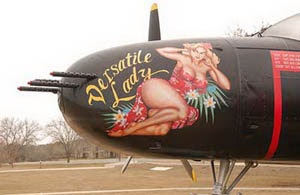
I start every poster design by researching what has come before. Dogfight is a relatively new show, so it doesn't have a long history of poster designs to look at. The original production poster is an illustration of the lead actors, which we didn't want for this show. Other posters have made different uses of dog tags and roses, which I didn't find to be particularly evocative and eye-catching. So instead, I started looking at imagery from the Vietnam War, which is the period the play is set in. Very quickly I was drawn to the idea of nose art.

Aircraft Nose Art From WWII

Nose art is a kind of graffiti painted usually on the nose of an aircraft. It became popular during World War II, the first war in which airplanes played a major role. Because air combat and bombing raids were so dangerous, airmen developed strong bonds with their planes, and nose art was a form of bonding. The German forces were known for painting aggressive imagery on the noses of their planes— bared teeth and angry eyes— while the Allied forces painted cartoons, taunts, and pinup girls. The paintings were officially against regulations, but most commanding officers, knowing it was a moral booster, turned a blind eye.

Nose art was still present in the Vietnam War but not quite as common because of the types of aircraft used. In WWII, American forces relied on bombers and fighter planes, but in Vietnam the military's main aircraft were helicopters. Helicopters don't have as much fuselage space to paint on, but you could still find some crews painting on them when they could.

This seemed to me a perfect embodiment of the themes of the show: the juxtaposition of the soldiers' idealized concept of a woman painted onto a machine of war, one that would get dirty and torn up over time. Sullivan loved this idea when I presented it to him, so then I began finding the building blocks of what would become our poster design.

To find that perfect idealized woman, I turned to a popular example of the objectification of women from the show's time period and earlier: classic pinup art. Once I found the right image, it was a relatively simple matter of scanning and isolating the image of the woman and overlaying it onto the fuselage of a military plane (in this case, a bomber from a photo I found online). By using digital brushes, masking, and other Photoshop wizardry, I was able to make the pinup art look like it had been painted directly onto the plane, and that it had, over time, gotten rubbed off and damaged. Despite all of the damage and wear though, the optimism and beauty of the underlying image still comes through, which fit the theme of the show. A smattering of bullet holes and metal rips helped show how much wear and tear this bird and received.

Dogfight poster, work in progress 2 Beginning: cleaned up fuselage and initial image placement Dogfight poster, work in progress 3Middle: Dirtied up the fuselage and painting, added text
Dogfight poster, work in progress 5Middle: more distressing overall and matched painting and fuselage lighting Dogfight poster, work in progress 6Final marketing image

The final touch was the lettering. Almost every instance of American nose art has some kind of label or title to it. Sometimes it was a reminder of home, sometimes it was a taunt to the enemy. My first thought was to label the painting "Rose" after the show's main female character. Because the play is set in San Francisco, this became "San Francisco Rose." While not bad, Sullivan suggested that somebody had written "Eddie" over the painting so it read "Rose + Eddie" like graffiti. That was exactly what the image needed. Before, it was simply an interesting image that resonated the themes. But by adding that hand-drawn "Eddie" to the existing art, we had a story. Who is Eddie? What is/was his relationship to Rose? Was Rose a real person? Did he scribble his own name on the plane or was this a taunt by one of his buddies? Suddenly, the image was alive with story and possibility.

We went on to use this image in many different configurations, from transit ads, posters, and postcards, to web banners of all configurations. Like any good marketing image does, it became the public face of the show and was strong enough to support an 8-week marketing campaign. Dogfight went on to become one of the most popular and successful shows of BoHo's 10-year history. This poster started with a simple conversation about ideas and themes, and came to life through exploration and collaboration.

This article was originally published at Grab Bag Media.

Monday, October 12, 2015

A Change in Perspective: by Tony Churchill

The following is a guest post by scenic designer Tony Churchill, who has designed video projections for BoHo's Ordinary Days and Dogfight.

I got on board for Ordinary Days pretty much how everyone gets a design job in this business: I knew the director. Working with the BoHos really surprised me and turned my view of this thing I’ve been doing for almost 20 years upside down; I never thought so much of my reality would be altered.

By the time tech for Ordinary Days rolled around, we started cuing the show right after a huge snowstorm and it was pretty much the usual crew when we started. As the day progressed, more and more people showed up. Some nice lady with an infectious laugh and delicious baked goods. PR guys who were super nice, and weirdly helpful. “Hey I’m here to take some pictures for Facebook, oh do you need help moving those walls?” And then the head Peter (I had met six or seven Peters with some kind of title in the company since the first production meeting). All of these personalities filled the room and it was a little unnerving. I’ve been on shows where they end up being directed by committee, and it NEVER works out. Who do you listen to? Do you follow the herd or try and make your own voice heard? It was unnerving.

By the third day of tech, I realized that this is what collaboration was supposed to be. Everyone wasn’t in the space on their own thing, they were in the space on a common thing. At face value, it's a bunch of crazy and committed - and beautiful - people who shouldn’t be able to find a cab, let alone put up a show. But they are so happy to be there that all the crap sort of peels off and you realize you're working in this perfectly collaborative place. The people in the room are working for the show and nothing more (or less). They want the show to be the very best thing it can be, not because of vanity, but because of pride. They're so happy to be free to be making something beautiful and true that they love.

After Ordinary Days, Peter Prime, AKA Peter Marston Sullivan, introduced me to Dogfight - which I had never heard - and I connected to it so quickly because my Dogfight experience is my BoHo experience. I value a lot of things in Dogfight, but where it gets especially hard is when it shows how a lot of men see women and it doesn’t pull any punches. It’s a hard portrait of how guys deal with their fear and insecurities. I think this is an obvious show for BoHo because they’re so good at coping with fear and dread that theatre companies often face and fail at overcoming as a cohesive group with a common goal. There is no job too big for the group and no job too small for any individual. It’s something you experience in spurts when working in a collaborative space like theatre, but it’s a rare a beautiful gift to find it so alive and well with an entire group again and again.

I’m thankful every time I’m able to work with the BoHo family because it reminds me what this whole thing is about. Their work is their pleasure - twenty-four seven, three sixty-five, they never close - and their passion is veritas. I’ve seen green interns on their first pro gig, making nothing but friends and memories, step up and single handedly do the work of four professional stagehands. I’ve seen the most senior member of the family take off their jacket and pick up a paint brush to get a set piece finished in time. It’s because you can feel it from the moment you’re in the room. You know - definitively - that you’re a part of something. A community. A family. A group of people who will not quit on you.

You want to do your very best because they want that from you too, and the BoHos will do anything - simply, quietly, beautifully - anything you need to be your very best. They challenge me gently and earnestly. They make me want to tweak and work things to death, because I can’t bear to let them down. That’s something you don’t find in every place - you don’t find it almost any place. If you get to work with BoHo, or you just support them by seeing the work, you’ll feel what I’m talking about too. This commitment - even in the hardest of times - is what it takes to make a show like Dogfight work. Boho is fearlessly committed to the truth - and love and beauty and freedom - because they go at it together. It’s not some silly mumbo jumbo - it’s real for them and everyone who gets to work with them. There’s not a lot of other companies that could make this piece work, because more often than not, most theatre companies shy away from the truth, especially when it’s tackling such difficult subjects.

At its core, theatre is pretty dumb. We’re not saving anyone’s life. We’re not feeding the hungry or healing the sick. We’re not even making anything lasting. But theatre at its best - like BoHo Theatre - is something that is vital to the human condition. It nurtures the soul by giving people something human that humans have always needed. A little time to tell stories with each other. More than 2000 years ago, the Greeks would build theaters next to hospitals because they believed these places were equally important to healing - one the body and one the soul. This is what I look for when I’m making theatre and it’s not easy to find. BoHo has it in spades. They sweat it out when they take over a space and make it a theatre - a real theatre. It’s the core of why theatre is one of the oldest traditions we share as humans. And it fills me with joy to be with them every time we make something together. Join, play, love.

-Anthony Churchill, Set and Media Designer

Friday, October 2, 2015

Why did our Artistic Director choose DOGFIGHT?

DIRECTOR PETER MARSTON SULLIVAN REVEALS WHY DOGFIGHT MOVES HIM

Peter Marston Sullivan headshot "The first time I listened to Dogfight, I was on a road trip on my own, listening to potential musicals for our 2015 season. When I finally popped in the cast recording, I listened to it three times in a row, each time growing more confident that this show was perfect for BoHo.

Dogfight starts as a party – dynamic full-cast numbers bursting with energy. The music is melodic and funny, driven and exciting. As I listened, I found myself caught up in the fun of the soldiers… then I slowly began to realize that this “fun” was misguided. I almost felt guilty for enjoying it at the start. But as the songs became increasingly haunting and heartbreaking, the show revealed itself to be an awkward yet charming love story. One woman, Rose – an ungainly, naive wallflower - has such purity in heart and spirit that she trusts, forgives, and ultimately loves unconditionally. Though perhaps not gorgeous in a conventional way, it became very clear to me that she is by far the most beautiful person in the show.

Peter Marston Sullivan leads the Dogfight cast in rehearsal


The response from our Dogfight audiences so far has been overwhelmingly positive. Yet there are still many people that have been wary of the show because of its central premise: a dogfight. One of BoHo’s staunchest supporters told me, “I knew what a dogfight was and found it repulsive.” And she’s right - it is. What I found so profoundly moving about this show - more so than the fantastic music and script - was how there was pure beauty to be found amongst this backdrop of repulsion. At a time, the 1960s, when we were so sure, so proud, and ultimately so naïve, when dogfights were commonplace and over 50% of the population had never heard of Vietnam, amidst all of that, there is one sole spark of beauty that contrasts all of the ugliness. The fact that it comes from someone that these Marines characterize as “a dog” is, in its own way, ironic and powerful.

In case you’re wondering what that same supporter felt after watching the show, her words may say it best: "Vietnam is part of my history, my era. Dogfight was sometimes outright painful to watch – even without the dogfight. Recalling how very certain all of us were, whatever our beliefs, it’s just heartbreaking. BoHo never flinched from that. It takes immense art and sensitivity to tell this story. You helped the audience find beauty [in it.]”

When you see BoHo’s Dogfight, what awaits you is a story that grabs you right from the start with energy and enthusiasm, laughter and immensely likable characters. What you leave with, I hope, is a feeling of beauty and love, comfort in the fact that even when there is ugliness all around us, there is always beauty to be found. This is why I love this show. This is why I wanted to tell this story.”

Peter Marston Sullivan signature
Peter Marston Sullivan
BoHo Theatre Artistic Director