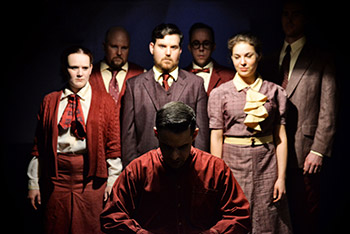
During the run of Hauptmann, we were lucky enough to sit down and have a round table discussion with three of our actors&mash; Chris Amos, playing Charles Lindbergh; Sasha Kraichnan, playing Anne Morrow Lindbergh; and Eleanor Katz, playing Bruno Hauptmann’s wife, Anna Hauptmann. These are the excerpts from that conversation.
BOHO: What was it like doing research in order to play these real characters? And how did that research inform what you do onstage?

SASHA: I was really lucky because Anne Lindbergh published her journals and letters from almost every year of her life. I didn’t know those existed when I first got the role, but I was looking through the bookstore and in the aviation section I saw Diaries and Letters of Anne Morrow Lindbergh and I said “Alright, I don’t care how much that costs. I’m bringing that home!”
And those diaries and letters gave me a sense of her voice, because she’s very gentle and very demure, but also very direct and to the point. She also writes a lot about grief and processing this whole experience-- or not processing it-- and how her and Charles as a couple did not really process it.
When Anne wrote about it being more difficult to watch her mother’s testimony in the trial than to be on the stand herself-- because she had more room to feel, she said-- I got the sense that she held herself very, very tightly. She held herself as tight as she could just to get through her delivery, and she would not express anything in a public setting. That helped me understand her.
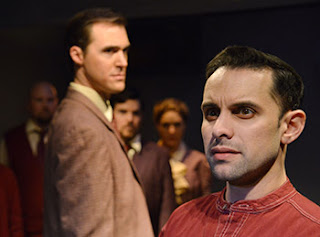
CHRIS: In my research, one of the things that struck me was just how much of a private person Lindbergh was. He was this giant public figure, but it wasn’t entirely anticipated by him just how huge flying a plane across the ocean would be to the public. And the way the public went insane about that really turned him inward.
It was right around this time in history that we changed from being a country that celebrated people who did things to a country that instead celebrated people who were just people, like celebrities and the culture of personality. I feel like Charles was one of the first victims of that.
In the play, there’s really only one private moment that Charles has and that’s at the end, and it’s kind of a relief to get to after all of the public figure scenes and the posturing-- just to see him as a human being at the end.

ELEANOR: There were a lot of articles written about Anna Hauptmann and her struggle. I’m from the Philadelphia area, which is where she ended up moving after the trial. She worked in a bakery that was run by a friend and she raised her son by herself. She never changed her last name and she never took off her wedding ring, and that helped inform me about who she was.
She also worked until the day she died to clear her husband’s name. And the state of New Jersey, mainly Governor Florio, who was the governor for a long time when I was a kid living in New Jersey, just completely rebuffed her and would never give her audience or reopen the case. So I think for me, when Anna reads Hauptmann’s farewell letter, his final words, to me it’s easy to be emotional. She knows that he’s going to be killed for something that she doesn’t believe that he did and he’s left her with a son. So that knowledge really informed how I deliver that piece.
CHRIS: Overall, it’s a very limited perspective we have on these characters in this play. It’s all seen through Hauptmann’s filter, so we’re not seeing all of who they are throughout the play. We’re just capturing those little bits and pieces that are relevant to his story.
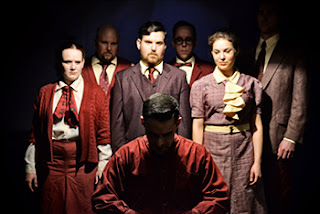
BOHO: Has doing this show influenced how you see sensational trials in the news?
CHRIS: I’m always skeptical of what I see in the news.
SASHA: And was before this.
ELEANOR: There has been “The Crime of the Century” so many times now that I think we already see how the court of public opinion plays into it-- sometimes more than actual evidence does. In Hauptmann’s case, they HAD to kill him whether he was guilty or not. The public demanded a scapegoat.
CHRIS: I always thought it was interesting how much Charles meddled in the whole investigation. He took charge of it, and was listening to these gangsters who would give him information, because (he said), “they’ve got connections in the criminal world.” They totally took advantage of him.
ELEANOR: I can’t believe he had the police wipe down the fingers prints on the ladder!
SASHA: He may have been part of it!
CHRIS: I don’t think he was part of it, I think he just incredibly mismanaged the whole thing. I think he was a father trying to find his child and took charge and made a bunch of horrible mistakes.
ELEANOR: But they all listened to him!
CHRIS: Yeah, because nobody was going to tell him “no,” and that’s what he really needed. He needed somebody more powerful than him to say, “Look, Charles, I know you’re...”
ELEANOR: Did that exist? Someone more powerful than him?
CHRIS: At the time? (thinks) Maybe the president.

BOHO: Do you have any favorite moments in the play?
CHRIS: I like to watch the trial scene. I like watching Nate[Randall Miller] as the lawyer just really drilling down on Hauptmann.
ELEANOR (to Chris): I like the beginning of your final scene with Hauptmann, because you’re just like two guys having a conversation.
SASHA: And the handshake at the end!
ELEANOR: You play that so well-- it’s not hateful or vengeful. You’re a human being talking to another human being, and I just love that. I think you were smart not to play the obvious angle.
CHRIS: That scene to me is really two people trying to find resolution-- trying to find closure in some way.
ELEANOR: Yes. I think that’s what’s lovely about it.
CHRIS: And they almost get it…. And then Hauptmann ruins it, like everything! (laughs)
Hauptmann by John Logan closes this coming weekend at The Heartland Studio in Rogers Park. For tickets, videos, photos, and more information, visit www.bohotheatre.com


 Posts
Posts


 Our Chicago theatre community is special in many ways. Since moving here six years ago, I have found it to be welcoming, generous, loving and creative beyond measure. I have lived all around the world and consistently find my true home and comfort when I am with my fellow magic makers. In Chicago, this happened amongst a group of artists with the biggest hearts on their broad shoulders – my Bohemians.