Showing posts with label actor insight. Show all posts

Tuesday, December 2, 2014

The Power of Giving

From the Desk of the Executive Director, Kaela Altman

As 2014 starts to wind down to a close I find myself feeling nostalgic and grateful. When BoHo closed Parade on November 16, our Company members gathered together to toast the season, and celebrate what an incredible 10th year we have had.

  • We produced four shows over the course of 16 months.
  • We received another record year of Jeff Nominations, which reminded us of our power to create incredibly thoughtful theater.
  • We saw over 1,000 people at general auditions throughout the year.
  • And we shared our artistry with well over 3600 patrons who came out to support Live Theatre in Chicago.

Last night, in Times Square, a "Bono-less U2" presented a surprise concert in honor of World AIDS Day. After an introduction from former President Bill Clinton, the stage was glittered with A-listers from Bruce Springsteen, Carrie Underwood, Kanye West, and many, many more in honor of those who have lost their battle with AIDS, and in celebration of those who have survived. President Clinton said that in 2013, more people received treatment than were diagnosed, an incredible feat given the state of this crisis some twenty years ago.

And that got me thinking about the Power of Giving. Whether it's $5 or $5,000, every single contribution makes an impact. Contributing doesn't just build a bottom line, or close a revenue gap.

Giving, in it's purest sense, unites a Community of people in support of a common cause.

Giving and Theater are similar in that regard and is representational of a Community of People, a Community of Artists, coming together to share their gifts, their hearts, and their passions which can collectively effect change.

BoHo is incredibly lucky to share this space with our fellow artists and we are incredibly grateful to everyone who gives to storefront. On this #GivingTuesday, I ask that you share your support for your cause today. Whether it is BoHo, your local food pantry or animal shelter, or perhaps another cause near and dear to your heart, celebrate the Power of Giving today and remember the spirit of the season.


Monday, April 15, 2013

Roundtable Talk With the Cast of Hauptmann

During the run of Hauptmann, we were lucky enough to sit down and have a round table discussion with three of our actors&mash; Chris Amos, playing Charles Lindbergh; Sasha Kraichnan, playing Anne Morrow Lindbergh; and Eleanor Katz, playing Bruno Hauptmann’s wife, Anna Hauptmann. These are the excerpts from that conversation.


BOHO: What was it like doing research in order to play these real characters? And how did that research inform what you do onstage?

Sasha Kraichnan as Anne Morrow Lindbergh in 'Hauptmann'

SASHA: I was really lucky because Anne Lindbergh published her journals and letters from almost every year of her life. I didn’t know those existed when I first got the role, but I was looking through the bookstore and in the aviation section I saw Diaries and Letters of Anne Morrow Lindbergh and I said “Alright, I don’t care how much that costs. I’m bringing that home!”

And those diaries and letters gave me a sense of her voice, because she’s very gentle and very demure, but also very direct and to the point. She also writes a lot about grief and processing this whole experience-- or not processing it-- and how her and Charles as a couple did not really process it.

When Anne wrote about it being more difficult to watch her mother’s testimony in the trial than to be on the stand herself-- because she had more room to feel, she said-- I got the sense that she held herself very, very tightly. She held herself as tight as she could just to get through her delivery, and she would not express anything in a public setting. That helped me understand her.
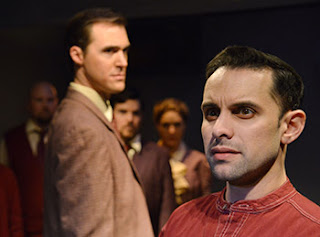
Chris Amos as Charles Lindbergh and Jeremy Trager as Bruno Hauptmann in 'Hauptmann'

CHRIS: In my research, one of the things that struck me was just how much of a private person Lindbergh was. He was this giant public figure, but it wasn’t entirely anticipated by him just how huge flying a plane across the ocean would be to the public. And the way the public went insane about that really turned him inward.

It was right around this time in history that we changed from being a country that celebrated people who did things to a country that instead celebrated people who were just people, like celebrities and the culture of personality. I feel like Charles was one of the first victims of that.

In the play, there’s really only one private moment that Charles has and that’s at the end, and it’s kind of a relief to get to after all of the public figure scenes and the posturing-- just to see him as a human being at the end.

Eleanor Katz as Anna Hauptmann in 'Hauptmann'

ELEANOR: There were a lot of articles written about Anna Hauptmann and her struggle. I’m from the Philadelphia area, which is where she ended up moving after the trial. She worked in a bakery that was run by a friend and she raised her son by herself. She never changed her last name and she never took off her wedding ring, and that helped inform me about who she was.

She also worked until the day she died to clear her husband’s name. And the state of New Jersey, mainly Governor Florio, who was the governor for a long time when I was a kid living in New Jersey, just completely rebuffed her and would never give her audience or reopen the case. So I think for me, when Anna reads Hauptmann’s farewell letter, his final words, to me it’s easy to be emotional. She knows that he’s going to be killed for something that she doesn’t believe that he did and he’s left her with a son. So that knowledge really informed how I deliver that piece.

CHRIS: Overall, it’s a very limited perspective we have on these characters in this play. It’s all seen through Hauptmann’s filter, so we’re not seeing all of who they are throughout the play. We’re just capturing those little bits and pieces that are relevant to his story.
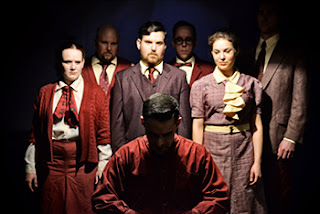


The cast of BoHo's 'Hauptmann'

BOHO: Has doing this show influenced how you see sensational trials in the news?

CHRIS: I’m always skeptical of what I see in the news.

SASHA: And was before this.

ELEANOR: There has been “The Crime of the Century” so many times now that I think we already see how the court of public opinion plays into it-- sometimes more than actual evidence does. In Hauptmann’s case, they HAD to kill him whether he was guilty or not. The public demanded a scapegoat.

CHRIS: I always thought it was interesting how much Charles meddled in the whole investigation. He took charge of it, and was listening to these gangsters who would give him information, because (he said), “they’ve got connections in the criminal world.” They totally took advantage of him.

ELEANOR: I can’t believe he had the police wipe down the fingers prints on the ladder!

SASHA: He may have been part of it!

CHRIS: I don’t think he was part of it, I think he just incredibly mismanaged the whole thing. I think he was a father trying to find his child and took charge and made a bunch of horrible mistakes.

ELEANOR: But they all listened to him!

CHRIS: Yeah, because nobody was going to tell him “no,” and that’s what he really needed. He needed somebody more powerful than him to say, “Look, Charles, I know you’re...”

ELEANOR: Did that exist? Someone more powerful than him?

CHRIS: At the time? (thinks) Maybe the president.


Sasha Kraichnan and Chris Amos as the Lindberghs, with Jeremy Trager as Bruno Hauptmann, in 'Hauptmann'

BOHO: Do you have any favorite moments in the play?

CHRIS: I like to watch the trial scene. I like watching Nate[Randall Miller] as the lawyer just really drilling down on Hauptmann.

ELEANOR (to Chris): I like the beginning of your final scene with Hauptmann, because you’re just like two guys having a conversation.

SASHA: And the handshake at the end!

ELEANOR: You play that so well-- it’s not hateful or vengeful. You’re a human being talking to another human being, and I just love that. I think you were smart not to play the obvious angle.

CHRIS: That scene to me is really two people trying to find resolution-- trying to find closure in some way.

ELEANOR: Yes. I think that’s what’s lovely about it.

CHRIS: And they almost get it…. And then Hauptmann ruins it, like everything! (laughs)


Hauptmann by John Logan closes this coming weekend at The Heartland Studio in Rogers Park. For tickets, videos, photos, and more information, visit www.bohotheatre.com

Tuesday, July 19, 2011

An Interview With The Team Behind Icarus

We asked the cast and crew of BoHos's 2010/2011 Season closer Icarus about challenges that the show has brought to the table. We hoped to get a glimpse into how each person has faced those challenges and embraced them!


Tom Chiola (Mr. Ellis) answered:
"What's challenging about playing a character who lives under the porch with his stuffed cat and has a suitcase full of dreams...you tell me! Which is better/worse—having the painful memory of a lost loved one or forgetting him/her altogether?—that's part of Mr. Ellis' dilemma."


Nicolas Gamboa (Primitivo) answered:
"The biggest challenge will definitely have to be doing flips and break dancing. Primitivo and I share an addiction to imagination that connects us deeply. But the biggest connection I find with the character is how we both put family above all."


BoHo presents Edwin Sanchez's IcarusDirector P. Marston Sullivan answered:
One of the most challenging aspects to directing this show is allowing the myth of Icarus to expose itself almost naturally, rather than focusing too much on broadcasting the inner meaning behind every moment.  There is the element of myth, of grandeur, of beauty and love; but it is hidden within the story in a manner that should be brought out with great craft and care.  Finding the reality of the characters, the great need and desire that each of them have - that is the key to bringing this story to life.  Sanchez has provided us with a very distinct and powerful framework, and a quintet of characters that are almost so odd they are hard to believe.  Making them real and believable, however, is what makes the show so emotionally powerful.  Finding the reality of the characters and entwining those realities with the mythological framework is the great challenge in Icarus.


Scenic Designer Sally Weiss answered:
For starters, it takes place on a beach, so the big question from the beginning was how do we create a beach? We don't have the means to bring in tons of sand, so we played with a number of options of suggesting sand and beach.  Peter, the director, wanted the space to feel intimate, since we're exploring very personal stories, but also wanted the expansive feeling of the beach and horizon.  In the end, we decided to allow the natural elements of beach and sky to fill the space, but keep the architecture of the porches intimate and clean.


Icarus run June 24 - July 24 at Theater Wit, 1229 W. Belmont Ave, Chicago. Visit the BoHo Theatre website for tickets and more information.

Tuesday, January 4, 2011

Elephant Man Actor Blog, Part 2: "When I Reach It, I'll Know"

We continue our series of behind-the-scenes glimpses from actor Mike Tepeli, who is playing John Merrick, the title character in BoHo's production of The Elephant Man, opening January 7th.
12/07/10

"Listening. Every professor, actor, and good director will talk about it. Its such a basic concept, and yet it’s the most difficult ‘phase’ of the process to reach. If my process were laid out in a pyramid, with the foundation being script work; the middle being movement work, acting exercises, and every tool we use to explore; the cap stone is simply listening. Everything else is used to inform how you react.

"This final stage always takes me a while to get to, but that’s why we rehearse, and why it’s called a rehearsal process; characters mature over time, and if I keep grinding along eventually I’ll reach ‘the moment’ That’s when I stop thinking about how things ‘work’; I’m not focusing on how Merrick moves, or how he talks, or how he gets from any point A to any point B. I’m just listening to my fellow actors, and reacting. I mean this in the most humble sounding way, but I know that moment happens because it’s explosive. Others may not even notice it, but I’ll know. It hasn’t happened yet, but I’m beginning to feel it. For now, lets just say it’s a series of tiny pops, that I’m hoping will become a large bang. I just gotta trust I’ll get there."

-Mike Tepeli, Dec 3.
Check back weekly or subscribe to the RSS feed to read more actor insights from The Elephant Man.

Tuesday, December 28, 2010

Elephant Man Actor Blog, Part 1

This is a post from Mike Tepeli, who is playing John Merrick, the title character in BoHo's production of The Elephant Man, opening January 7th.

A reporter once asked Meryl Streep, then rehearsing a new adaptation of Mother "Courage by Tony Kushner for Shakespeare In The Park, what is the job of an actor? 'I am the voice of dead people,' she responded. Short and cryptic, but strangely accurate, that answer is sometimes literally true. It's always exciting to play a real person, and also nerve wrecking. How you walk, sit, respond in anger and in grief, everything you do someone literally did. I think words like good, wrong, and right have no place in a rehearsal, but it's hard not to think there must be a 'right way of doing it' for a historical character: So, you research and read your script, you look at pictures, you read journals and then read your script again.

"Eventually, you start seeing discrepancy's, little differences between the script and the historians. It could be the timeline, character description, anything really. It’s good to know numerous perspectives, but too many choices can cause doubt. The life of John (or Joseph as his birth certificate says) Carey Merrick is muddled and mysterious enough; what do I pull out as 'the right way' of the numerous conflicting accounts? I think, and I know [director] June Eubanks does as well, that you should research as much as you want, but in the end, you have to play Bernard Pomerance's script, and his John Merrick. Research is a tool, and there is no ultimate right.

"I don't wanna give too much away, but our concept lends itself to that theory. In this world, we are actors portraying real people, and I mean that quite literally. It’s a freedom that should be less strange to the actor and the theatre audience; suspending our belief, and imagining. We are just scratching the surface right now, but I can't wait for what’s ahead. Being a dead guy’s voice is pretty thrilling."

-Mike Tepeli, Nov 20.


Check back weekly or subscribe to the RSS feed to read more actor insights from The Elephant Man.