Showing posts with label behind-the-scenes. Show all posts

Monday, April 15, 2013

Roundtable Talk With the Cast of Hauptmann

During the run of Hauptmann, we were lucky enough to sit down and have a round table discussion with three of our actors&mash; Chris Amos, playing Charles Lindbergh; Sasha Kraichnan, playing Anne Morrow Lindbergh; and Eleanor Katz, playing Bruno Hauptmann’s wife, Anna Hauptmann. These are the excerpts from that conversation.


BOHO: What was it like doing research in order to play these real characters? And how did that research inform what you do onstage?

Sasha Kraichnan as Anne Morrow Lindbergh in 'Hauptmann'

SASHA: I was really lucky because Anne Lindbergh published her journals and letters from almost every year of her life. I didn’t know those existed when I first got the role, but I was looking through the bookstore and in the aviation section I saw Diaries and Letters of Anne Morrow Lindbergh and I said “Alright, I don’t care how much that costs. I’m bringing that home!”

And those diaries and letters gave me a sense of her voice, because she’s very gentle and very demure, but also very direct and to the point. She also writes a lot about grief and processing this whole experience-- or not processing it-- and how her and Charles as a couple did not really process it.

When Anne wrote about it being more difficult to watch her mother’s testimony in the trial than to be on the stand herself-- because she had more room to feel, she said-- I got the sense that she held herself very, very tightly. She held herself as tight as she could just to get through her delivery, and she would not express anything in a public setting. That helped me understand her.

Chris Amos as Charles Lindbergh and Jeremy Trager as Bruno Hauptmann in 'Hauptmann'

CHRIS: In my research, one of the things that struck me was just how much of a private person Lindbergh was. He was this giant public figure, but it wasn’t entirely anticipated by him just how huge flying a plane across the ocean would be to the public. And the way the public went insane about that really turned him inward.

It was right around this time in history that we changed from being a country that celebrated people who did things to a country that instead celebrated people who were just people, like celebrities and the culture of personality. I feel like Charles was one of the first victims of that.

In the play, there’s really only one private moment that Charles has and that’s at the end, and it’s kind of a relief to get to after all of the public figure scenes and the posturing-- just to see him as a human being at the end.

Eleanor Katz as Anna Hauptmann in 'Hauptmann'

ELEANOR: There were a lot of articles written about Anna Hauptmann and her struggle. I’m from the Philadelphia area, which is where she ended up moving after the trial. She worked in a bakery that was run by a friend and she raised her son by herself. She never changed her last name and she never took off her wedding ring, and that helped inform me about who she was.

She also worked until the day she died to clear her husband’s name. And the state of New Jersey, mainly Governor Florio, who was the governor for a long time when I was a kid living in New Jersey, just completely rebuffed her and would never give her audience or reopen the case. So I think for me, when Anna reads Hauptmann’s farewell letter, his final words, to me it’s easy to be emotional. She knows that he’s going to be killed for something that she doesn’t believe that he did and he’s left her with a son. So that knowledge really informed how I deliver that piece.

CHRIS: Overall, it’s a very limited perspective we have on these characters in this play. It’s all seen through Hauptmann’s filter, so we’re not seeing all of who they are throughout the play. We’re just capturing those little bits and pieces that are relevant to his story.
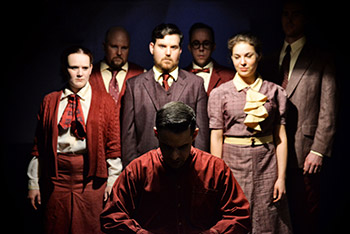


The cast of BoHo's 'Hauptmann'

BOHO: Has doing this show influenced how you see sensational trials in the news?

CHRIS: I’m always skeptical of what I see in the news.

SASHA: And was before this.

ELEANOR: There has been “The Crime of the Century” so many times now that I think we already see how the court of public opinion plays into it-- sometimes more than actual evidence does. In Hauptmann’s case, they HAD to kill him whether he was guilty or not. The public demanded a scapegoat.

CHRIS: I always thought it was interesting how much Charles meddled in the whole investigation. He took charge of it, and was listening to these gangsters who would give him information, because (he said), “they’ve got connections in the criminal world.” They totally took advantage of him.

ELEANOR: I can’t believe he had the police wipe down the fingers prints on the ladder!

SASHA: He may have been part of it!

CHRIS: I don’t think he was part of it, I think he just incredibly mismanaged the whole thing. I think he was a father trying to find his child and took charge and made a bunch of horrible mistakes.

ELEANOR: But they all listened to him!

CHRIS: Yeah, because nobody was going to tell him “no,” and that’s what he really needed. He needed somebody more powerful than him to say, “Look, Charles, I know you’re...”

ELEANOR: Did that exist? Someone more powerful than him?

CHRIS: At the time? (thinks) Maybe the president.


Sasha Kraichnan and Chris Amos as the Lindberghs, with Jeremy Trager as Bruno Hauptmann, in 'Hauptmann'

BOHO: Do you have any favorite moments in the play?

CHRIS: I like to watch the trial scene. I like watching Nate[Randall Miller] as the lawyer just really drilling down on Hauptmann.

ELEANOR (to Chris): I like the beginning of your final scene with Hauptmann, because you’re just like two guys having a conversation.

SASHA: And the handshake at the end!

ELEANOR: You play that so well-- it’s not hateful or vengeful. You’re a human being talking to another human being, and I just love that. I think you were smart not to play the obvious angle.

CHRIS: That scene to me is really two people trying to find resolution-- trying to find closure in some way.

ELEANOR: Yes. I think that’s what’s lovely about it.

CHRIS: And they almost get it…. And then Hauptmann ruins it, like everything! (laughs)


Hauptmann by John Logan closes this coming weekend at The Heartland Studio in Rogers Park. For tickets, videos, photos, and more information, visit www.bohotheatre.com

Tuesday, February 5, 2013

Pygmalion: The Fun and Challenges of Acting Shaw, with the Higgins Family

The family unit is an integral part of George Bernard Shaw’s Pygmalion. In past posts, we’ve explored how the Eynsford-Hill family presents strong foils for the primary characters, and examined what similarities exist within the Doolittle family. Today, we finish our series by talking to actors Lisa Herceg and Steve O’Connell about the relationship between mother and son in the Higgins household.

HENRY AND WOMEN

Henry Higgins and his mother

Throughout the play, Henry Higgins behaves impulsively and with considerable distain for society’s rules and manners. Few people are able to keep him in line except for his mother.

“I think that Mrs. Higgins is one of those very bad mothers who did a sudden switch,” says Lisa, who plays Henry’s mother. “She doted on him so much early on in his life that there was no need for him to behave appropriately according to society. Then once he became a man, she said ‘Now you need to behave in this certain way,’ And it didn’t work.”

“She created the beast, and then all of a sudden wanted it to be tame,” observes Steve, who plays Henry.

Mrs. Higgins, like a good doting mother, is concerned about her son finding a romantic love interest. In the play, Henry brushes off his mother’s laments about his lack of a love life by proclaiming “My idea of a loveable woman is someone as like you as possible!”

“I think that the key word in that phrase is ‘loveable,’” Steve says. “Henry understands that women are attractive and that they’re amusing, but the difference between that and loving a woman and having that sort of romantic relationship… he would want somebody who dotes on him as much as his mother does, someone who is not interested in seeing things and being seen and being part of the societal parties and soirees.”

“Well and someone who doesn’t take any guff from of you,” Lisa observes wryly.

“I don’t think he would ever admit that, but yes,” Steve concedes. “He is attracted to that without even knowing it. I think we see that in Scene 5 with Eliza, and how she won’t just bend to his will. There’s something enormously attractive about that, and he has no idea what to do with it. Women have defined roles in his life, like his mother and his housekeeper, and he thinks he has Eliza’s role defined, but it ends up not being defined for him. It’s the fact that he can’t pin it down that’s very attractive and very frightening at the same time.”

THE HIGGINS’ POSITIVE OUTLOOK

Higgins with Eliza
“I’m a really big believer that whatever the audience sees and takes away from the show is an individual experience, and that experience is always correct. I’m very hesitant to talk about process in a way that seeks to influence what somebody’s experience might be.” -Steve O'Connell

There is a danger in playing Henry Higgins that he might come across as cold and removed because of the density and intelligence of the language. The other characters often refer to him as a bully, a brute, rude, and having no manners. But Steve took a unique approach to the character.

“I think the key for him is that he’s excited about life. He’s just so excited about the possibilities of what life has to offer, and if you play excited— even if you’re barreling over people—, there’s a twinkling in the eye and an openness of the heart, and I think that with that in mind, you can sort of forgive a person like that. If the heart is open, then I think, as an audience and as other people in his life, we’re more willing to be like ‘Oh, it’s just that guy. It’s just Henry being Henry.’ Instead of thinking, “What a jerk!’”

Lisa agrees. “He always seems like a gigantic golden retriever puppy to me. Like, he has no idea how big he or what kind of mess he’s making.”

“I can see how the language sort of draws you into thinking of him as being cold and removed, but the first time I sat down and read the play, I was like ‘man, this guy just really loves what he does and is very excited about trying to convince everybody else that the study of phonetics is this wild and crazy time!’ He really believes that it can change the world. And that philosophy is not cold or removed at all. It’s all about trying to connect with other people. He just wants to connect on his own terms and his own way, and that’s kind of where the disconnect comes from. But it all starts in a positive place, in a connecting place. If you started with a cold ‘I’m better than you and don’t want to deal with you’ attitude, where would you go for two hours?”

A similar positivity can be found in the actions that Mrs. Higgins takes through the play.

“You would think that the train wreck that is Eliza would send her reeling,” notes Lisa, “and you’d think she would want to get this train wreck out of her drawing room as quickly as possible. But instead, she leaps to Eliza’s defense when Freddy is laughing at her. She asks Freddy if he’d like to see her again, which would indicate that she wants Eliza to come back. She takes her in when she leaves Henry. She’s really going out on a limb for this kid. She’s an outgoing and compassionate woman.”

AN UNUSUAL PASSION

Shaw’s plays are known for being full of rich language and dense with ideas, and Henry Higgins is a unique character in his obsession with dialects, sounds, and the way people speak. We asked Steve why he thought Higgins is so fascinated and drawn to the study of phonetics.

“Why is anybody fascinated and drawn to anything?” Steve replies.”I’m sure it was something that just piqued his interest when he was younger. I think it stems from the fact that he was just good at it and it was an intellectual pursuit that I think not a lot of other people were very interested in, and therefore he could shine. Especially when he was a younger person, I think he was very interested in being the best at something, and if he wasn’t the best at it, he didn’t have time for it.

“And then it became a passion. Things don’t become a passion right away until you learn more about them. And I think that has been and continues to be a life-long process for him. But the initial attraction I think came from success, which is kind of like a drug for him.”

THE LANGUAGE AND PHYSICALITY OF SHAW

Mrs. Higgins
“I am not accustomed to working from the outside in. I am accustomed to coming from the inside out, and the physicality comes as I’m working more on the character.”

In addition to being an ensemble member with Stage Left, Lisa is also a member of Babes With Blades, a company which focuses on stage combat in their productions. Most recently, Lisa played the title role in their production of Susan Swane and the Bewildered Bride. Transitioning from that role to Mrs. Higgins, who spends almost all of the play sitting in a chair, was a challenge.

“It drove me bananas the first three weeks,” Lisa confesses. “I thought I was going to lose my mind. And then I realized why I was being asked to be so still and not move, and I started to visualize the character. I am not accustomed to working from the outside in. I am not an “outside-in” kind of actor. I am accustomed to coming from the inside out, and the physicality comes as I’m working more on the character. When I got it, I got it, but I had some work to do to get to it.” -Lisa Herceg

Steve also found working on Higgins from a physical place to be helpful. “I’m usually more of an “inside-out” sort of person,” he says, “but with Higgins, when I started really physicalizing him and letting him talk with his hands and using the length of my body, that really helped. That was a continuation of the character that I couldn’t have done if I was just looking at the lines. And it also brought a kind of lightness and enjoyment that I was seeking, that came from a purely physical place first rather than an intellectual place.

“I found that I’ve been able to work from that place on the last few projects that I’ve done. I said to myself, ‘Just let your body do what it wants to do and don’t judge it,’ and it’s been really liberating. I used to think, ‘No, I have to intellectually figure out what’s going on first.” But that’s not how people act in real life. You don’t figure things out first and then act; often times you’re informed by what your body is telling you to do. That’s something that has been relatively new in my work as an actor: letting physical things inform the emotional.”

“In this case, the language informs it,” Lisa adds, “because these characters have very specific rhythms in their speech, and they’re all slightly different. How my character sounds was a big part of how I approached working on her.”

“I had a great teacher in grad school who did a lot of Shaw,” Steve says, “and he talked about how doing Shaw was like riding a bicycle in a crowded attic. You’re in a confined space, and there is no place to stop and put your foot down, so you always have to just keep driving. And there are so many boxes in the attic that you always have to make these twists and turns, and if there’s a box in front of you, you have to slow down and go around it. It’s all about down shifting and moving and adjusting, but never stopping.

“Describing Shaw’s language in that visual way just made sense to me. It was a great image for me eight years ago, and I came back to it here.”

You can see the Higgins family in action in BoHo and Stage Left Theatres’ joint production of Pygmalion, now playing at Theater Wit until February 10th. Do you have thoughts on the characters or our actors’ approach to them? Leave a comment below and join the conversation!

Wednesday, January 30, 2013

Pygmalion: Catching Up With The Doolittles

George Bernard Shaw’s Pygmalion shows us three very different family units. We’ve already peeked behind-the-scenes at the trio of secondary characters that make up the Eynsford-Hill family. The next family is the Doolittles: Eliza and Alfred. While the two characters are family, they share little stage time together, and the particulars of their relationship are left up to the actors playing them. We caught up with our actors backstage before the show one day.

SOLITARY LIFESTYLES

Pygmalion production photo

“I don’t think that the characters really have much of a relationship,” says Stage Left Ensemble Member Mark Pracht, who plays Eliza’s father, Alfred Doolittle. “It says in the script he hasn’t seen her in two months, and I don’t think that’s unusual. I have it in the back of my head that Alfred has, like, 28 kids that are all running around London and he hardly sees any of them.”

“Her falling in with Higgins is just an opportunity for him to suck some money off of somebody. I think that’s just of the nature of that family, at least from Alfred’s perspective. He lives for himself. He doesn’t want to take care of a kid. If forced to he will, but he doesn’t really want to. So the fact that Eliza is able to take care of herself with selling flowers means he doesn’t have to deal with her.”

Stage Left Ensemble Member Mouzam Makkar, who plays Eliza, concurs. “I feel like Father Doolittle was just this remote presence in the household. She does tell the story of “my aunt died of influenza, but my father, he kept ladling gin down her throat…” So I feel like he was around, but they didn’t really talk. But I knew he was my dad and he would come by sometimes and-“

“And ask if you have money,” chimes in Mark.

“Exactly,” says Mouzam. “I feel that was pretty much the extent of the relationship.”

AN OPPORTUNISTIC STREAK

Mouzam Makkar as Eliza Doolittle
”Early on in the show, I’m doing a lot of just touching things, because I feel like Eliza probably hasn’t touched, for instance, nice engraved wood or plush couches, and I just totally imagined her being very sensory and touching and smelling things.”
-Mouzam Makkar

Still, the two characters came from the same neighborhood and the same class structure, and even if they didn’t have much interaction, they do share some familial similarities. “There is a certain assertiveness to the characters,” admits Mark. “The ability to just walk into the Higgins household and ask for what they want— that takes a certain disdain for the class structure. They’re both very opportunistic people. I think that’s probably on the Doolittle coat of arms: ‘Do for yourself.’”

Mouzam agrees. “Yeah, Doolittle is a smart guy, he knows where his strengths are, he knows what he can do, and I feel like Eliza knows what she is capable of too.” This is aptly demonstrated in the first scene of the play, in which Eliza rallies the crowd to her defense when she feels she might be arrested. “They both know how to manipulate a situation. They’re not strangers, she just knows ‘this is how I do my thing and this is how he does his.’”

COSTUMES AND BEARDS

Mark Pracht as Alfred Doolittle
“The interesting thing about Alfred’s argument as to why he should be given the money for Eliza is really hilarious to me, because at the time the concept of a dowry was pretty common, and I think that’s the way he looks at it: you’re taking my daughter, and that means you give me some money. He’s adept at using the society against itself.
-Mark Pracht

Mouzam and Mark are each drawn to their characters for different reasons.

“I love how strong Eliza is,” says Mouzam. “And it’s a role that kind of scared me at first, and I thought that meant I should probably audition for it. Because how often do you get the chance to say, ‘If get this role, then crap— I’m going to need to really figure this out and work hard at it!’”

For his role as Alfred, Mark has been specifically highlighted in many reviews, such as in the Chicago Sun-Times, which noted that he “mines every ounce of the comedy and self-awareness in Eliza’s dad.”

“I describe it as sort of a paratrooper role,” muses Mark. “You drop in, you say some funny stuff, and then you leave. And that’s always fun to do. You don’t have to carry the show.” No, but he certainly steals every scene he’s in. “I would never say I do that,” he demurs.

For this role, Mark grew an impressive set of friendly mutton chops, a style in which the mustache and side burns are connected. “In the last couple of years, I’ve been lucky enough to do parts that required me to do fairly extensive makeup, of one kind or another, and I really enjoy that,” Mark comments fondly. “I enjoy the idea of looking in the mirror and being about to go onstage and not seeing me, but just seeing the character. That’s also why I enjoy getting the costume. Thing don’t really come together for me until then.”

Speaking of costumes, Mouzam undergoes no less than five complete costume changes in the course of the two hour show. The evolution of these costumes also helped inform her acting choices. “The first costume I wear is so bulky and I can just slouch and be on the ground and I don’t think about ‘is my skirt set right?’ Plus I get to put dirt on my face and have scraggly hair. That really helps define early Eliza.”

“And then I get to do a slow transformation, where I take the dirt off first, and then I put all of my hair up, which makes me think, ‘oh, I don’t have anything on my shoulders now, this is nice,’ and then I get to put on the nice dress. My dresses get more and more constrained as the evening goes on, and that really does help me get to the point at the end where I’ve become a lady.”

You can see the Doolittles in action in BoHo and Stage Left Theatres’ joint production of Pygmalion, now playing at Theater Wit until February 10th. Do you have thoughts on the characters or our actors’ approach to them? Leave a comment below and join the conversation!

Sunday, January 27, 2013

Pygmalion: Dialect Coach Lindsay Barlett Sounds Off On Working With Our Actors

In our continuing series of posts looking behind-the scenes at BoHo's co-production of Pygmalion with Stage Left Theatre, we got a chance to talk to Dialect Coach (and Artistic Director of 20% Theatre) Lindsay Barlett on how she approached her work for this show.

Working on Pygmalion would seem to be a dialect coach's dream because it's a show all about dialect. Where do you start with a play like this? What is your process for gathering info?

Lindsay: This show is definitely a dialect coach's dream but then again any show with a vast amount of dialects is a dream to do because it challenges me. When I got the job working on this show I watched a lot of My Fair Lady as well as taped versions of Pygmalion just so I could get the tone. I also, as per usual for the shows i worked on, started gathering worksheets and voiced examples to not only use but pass on to the actors. A lot of my process happens after the show is cast and the rehearsals have begun because then I can witness how well a person will do with a specific dialect and whether we can tailor it or not.

What is the most fun about being a dialect coach?

Lindsay:I think the most fun thing about being a dialect coach is watching people become somebody different. Even when an actor is in their normal street clothes when you watch them put on a dialect they become a completely different person even though they are just changing the sounds that are coming out of their mouth. I kind of see it as a super power and I taught them it. I think Higgins nails it on the head when he says "you have no idea how frightfully interesting it is to take a human being and change her into quite a different human being"

What is the most challenging aspect about what you do?

Lindsay:I think the most challenging aspect about what I do is that sometimes people just can't do dialects. It's the same was as singing, not everyone is born with that talent and it takes time. It's very difficult sometimes to carve out time with an actor to work on dialect stuff because the blocking, working and general rehearsal process takes precedent but the dialect work sometimes takes the longest.

What is something that you think people don't realize about what you do?

Lindsay:I think that people don't realize how long dialect work takes. It's a different sort of designer schedule than more prominent designers like set or costumes. A Dialect Coach has to be available as often as possible at rehearsals and outside of rehearsals. Coaches are essentially an extension of the cast and not the production team.

Where do you find the time to be so knowledgeable about dialects AND be an artistic director at the same time?

Lindsay:sometimes I ask myself that very same question ;) To be honest, dialects come very easy to me, it's second nature and I have been doing them since I was a little kid so it is easy for me to translate what I know into teaching it to other people...I also am addicted to coffee and can run on very little sleep.

You can learn more about Lindsay on her website: www.lindsaybartlett.com. You can also hear all of Lindsay's carefully crafted sounds in person: Pygmalion is currently running at Theater Wit through February 10th. Learn more...

Friday, January 25, 2013

Pygmalion: Tips on Playing the Same Role Twice from Sandy Elias

Colonel Pickering appears in every scene of Pygmalion as Henry Higgins’ steady companion, eager to dissect dialects and help train Eliza in becoming a proper lady. As a counter point to Higgins’ disinterest and cruelty, Pickering offers a kind, supportive, grandfatherly presence to Eliza. But what really makes him tick?

A FAMILY AT WIMPOLE STREET

Pygmalion production photo Stage Left Theatre Ensemble Member Sandy Elias plays Pickering in our production. He believes Pickering leaps into the task of training Eliza—going so far as to move into Higgins’ apartment at Wimpole Street—because he’s attracted to the youthful energy there. “I used to be a college professor,” Sandy says, “and it’s a lot of fun to teach somebody. That’s the best way to learn a subject—to try to teach it to somebody else. Just being in that kind of environment of learning and watching Eliza develop is fun and exciting for him. He says it in the play: ‘It makes me feel young again.’

“So that’s part of what keeps him there. But it’s also genuine affection for Higgins and Eliza, and Mrs. Pearce, who takes care of everyone. It’s like an adopted family.”

“That’s one of the reasons I do plays,” Sandy continues. “It makes ME feel young again, just being involved in that kind of energy. Obviously, Steve [O’Connell] has tremendous amount of energy, as does Mouzam [Makkar], and it just carries into our offstage life.”

PICKERING REVISITED

Sandy Elias headshot Our production is not the first in which Sandy has played Colonel Pickering. He first played the role five years ago with Southwest Shakespeare Company in Arizona. Recreating a role under new circumstances is a unique challenge.

“Part of the trick, for me, was to forget about the other production I did and just play the moments as they occur in this one. That’s a bit of a challenge because sometimes I’ll be thinking about what happened last time, and maybe how this other kid delivered that line last time. But it makes you realize the organic, marvelous nature of live theatre. As you know, each performance is different, and obviously each production is different. So it’s kind of fun!”

SWEET HOME CHICAGO

Sandy is a graduate of Northwestern University’s theatre program. “When I moved to Chicago, I was 18, and I started at Northwestern in their summer theatre program. I had a wonderful time! I really owe a lot to Northwestern. It’s a great school, and I met some great people there.”

In all his years traveling around the country for theatre—and in working for over a decade at the Southwest Shakespeare Company—one thing stands out to him. “Every actor that I meet, when I’d tell them I was retiring from my teaching post and going back to Chicago, they were all jealous. They all want to be here, because the scene is so vibrant and alive… You can’t beat this city!

Catch Sandy's work while you can: Pygmalion is currently running at Theater Wit through February 10th. Learn more...

Sunday, January 20, 2013

Pygmalion: How Stephanie Sullivan discovered Mrs. Pearce

In our co-production of Pygmalion with Stage Left Theatre, BoHo's own Casting Associate Stephanie Sullivan plays Mrs. Pearce, housekeeper to Henry Higgins. She shared with us the process behind finding her approach to the character.

Stephanie Sullivan

"The path to discovering Mrs. Pearce has taken many different turns, especially because in the beginning, I wondered how I would take a character that is traditionally played by an older woman and make her story believable in the context of our production.

"The simple answer to the age thing? Mrs. Pearce has simply known Higgins her whole life, which affords her the knowledge she needs to 'handle' him (perhaps she even inherited her role from her mother, who would have been around to help raise Higgins.) Although my Mrs Pearce wouldn't have been around to help with the raising, she's been around long enough understand what it takes to manage him. She knows her position in life, but also knows that he could never manage without her. I've had a lot of fun in discovering what that fine line is— there's a balance between what her station in life dictates, and what her personal relationship with Higgins will allow.

"Luckily, I had a lot of inspiration to draw from; shows like Downton Abbey have prompted a whole new level of interest in the life of maids and footmen, many of which aren't too far from my actual age! In fact, one of the first things I remember Vance saying early on was, "I think of Mrs Pearce as someone kind of like Mrs O'Brien, but softer." Indeed, I think Mrs Pearce has the conviction and tenacity of Mrs O'Brien, without her cunning, scheming quality.

"The other fun thing we played with was dialect. Early on I rehearsed the script with standard RP in mind, but Vance wanted Mrs. Pearce's dialect to reflect a class distinction. We also knew that in the presence of a dialectician she couldn't sound anywhere near as bad as Eliza— no way he would be able to tolerate that for years!

Pygmalion production photo

It was Peter Robel who planted the seed of using a slightly Northern English influence in the dialect, which I feel has given this character a whole new flavor and life! Somehow this new direction made her much more three-dimensional, and brought qualities to her character that I wouldn't have discovered otherwise.

"What a fun show to be a part of! I am truly grateful for the experience and grateful to have worked with such an amazing cast and crew!"


Catch Stephanie's hilarious work while you can: Pygmalion is currently running at Theater Wit through February 10th. Learn more...

Thursday, January 17, 2013

Pygmalion: A Look at the Research Process with Skye Robinson Hillis

In our continuing series of posts looking behind-the scenes at BoHo's co-production of Pygmalion with Stage Left Theatre, we spoke with dramaturg Sky Robinson Hillis about how she approached researching a period show with this much history.

How to you get started when you're putting together research for a show? What's your first step?

Skye: It depends on the type of play you're working on, and whether or not it's a new play. Usually I begin with research of the era, particularly with a play like this. The time period is always the jumping off point for me. It usually guides me in the right direction. Everything starts there.

How do you anticipate what research might be most useful for the production team?

Skye:Anticipation is not always reliable, so I prefer just to ask them. I lay the groundwork and then if there's something specific they need me to focus on, better to find that out sooner than later. But generally, I would say we all tend to be interested in the same thing, and have a similar idea of what's important, as per the director's vision.

Drowning in information is possibly even less useful than having no information at all.

Where do you find your information? What has been your most interesting source for Pygmalion?

Skye:All over. Both the library and the internet. They each have their strengths and weaknesses. For this production, I read a lot of books on Victorian and Edwardian etiquette, so I became "Miss Manners." Maybe due to the time period we were looking at, the library was actually the more useful of the two. My most interesting source was actually this fantastic website that essentially turned Victorian England into an interactive Google map-type deal and allowed us to explore the city of London at that time. (I would include the link, but evidently now you have to pay for it.)

What is the most fun about being a dramaturg?

Skye:I'm just a giant nerd, so just about everything is the most fun thing. Working on this was especially so because Pygmalion has been one of my favorite plays since I was about thirteen and this was the first time I'd had any opportunity to actually be involved in a production of it. Researching the relationship between George Bernard Shaw and Mrs. Patrick Campbell is pretty much just an average Friday night for Skye Robinson Hillis, so it was a blast.

What is the most challenging aspect?

Skye:The most challenging aspect tends to be the filtering the information. Picking and choosing from all the gems you've discovered in order to focus on what's most relevant to the production, to the play we're making. But it's important to make those decisions and not overwhelm. Drowning in information is possibly even less useful than having no information at all.

Pygmalion is currently running at Theater Wit through February 10th. Learn more...

Sunday, January 13, 2013

Pygmalion: Crafting the Costumes with Theresa Ham

In our continuing series of posts looking behind-the scenes at BoHo's co-production of Pygmalion with Stage Left Theatre, we sat down with long-time BoHo Costume Designer Theresa Ham to discuss how she approached her work for this show.

Theresa: Designing Pygmalion was a big challenge, not only to create a beautiful full world, but working with the artistic visions of two companies. I have worked with BoHo for eight years, so I feel like I have a good grip on the artistic ideals for that company. But adding in Stage Left Theatre's artistic director Vance Smith, brought a new voice to my work with the company. I am always excited to work with new people, and this experience has been really great!

Pygmalion, Scene 3

How to you get started when you are putting together costumes for a show? What's your first step?

My first step is always to make a list of needs for the show. For example, what are the must haves that are referenced in the script and then discuss how to create the overall look with the director, in this case Vance Smith. Once I have a list of needs and a visual direction, I either draw, do research, or begin pulling items from stock sources.

Where do you find your inspiration in general? What about your inspiration for Pygmalion?

Theresa:I think inspiration can come from anywhere! As an artist, I am influenced by everything: fashion, studio art, nature, history, ect. Pygmalion is a period piece, meaning it is rooted in a past era, so when I have a project like this, the first place I look for inspiration is fashion books that illustrate the style of clothing during the given period— in this case, 1905-1912. From there, I can decide color and fabric to create a complete look.

Pygmalion, Scene 4

What do you find to be the most fun aspect of designing costumes for the stage, especially a period piece like this?

Theresa:The most fun is recreating the style of the period: really getting into how each character would present themselves given the style of the time. I really love watching actors get dressed in period costumes. It always effects their posture, demeanor, and movement. I think it helps them feel more appropriate, and it always makes me feel good to have the costumes make a positive impact on the actors.

What is the most challenging aspect about what you do?

I think my biggest challenge is to get inside each character. As an actor, you really have to know the character you are portraying, but as a costumer, you are making choices about every character in the play. I have to know how each character fits in the social ladder of the piece, how they view themselves, how their inner emotions might effect their clothing choices, and then how to convey that knowledge through costume to the audience! It's a big task, and I often rely on the director and actors to help me make those tough choices.

Pygmalion, Scene 6

What is something that you think people don't realize about your craft?

It is extremely collaborative. I work with everyone involved in the production. My work begins with the director, but I also need to communicate with the scenic designer (who creates the environment), lighting designer (who creates the emotional environment), actors (who actually wear the clothes), producers (funding and artistic vision), stage mangers and crew persons (who give our show continuity and make sure it can actually all work together backstage). If I am unwilling to collaborate and work together with others, my work will never be as good as it could be, because all of these people are inherently a part of it.

Pygmalion cast

See Theresa's beautiful costumes in action: Pygmalion is currently running at Theater Wit through February 10th. Learn more...

Tuesday, January 8, 2013

Pygmalion: Behind the Scenes with the Eynsford-Hill Family

You’ve no doubt heard of Henry Higgins and Eliza Doolittle, either from George Bernard Shaw’s classic play Pygmalion or its musical reimagining, My Fair Lady. But how much do you know of the Eynsford-Hill family? This trio of secondary character s pops up to provide some comic relief, but also shine a light on the main characters and help define them for us.

THE SPOILED GIRL

Rebecca Mauldin headshot
“I think Clara is a fabulous character. Sometimes those sort of character roles are especially appealing to me, because they have a lot of places you can take them.”

BoHo’s own Casting Associate, Rebecca Mauldin, plays the spoiled young lady Clara Eynsford-Hill in our joint production of Pygmalion with Stage Left Theatre “She seems to be a very one-dimensional character upon the first read,” she says. “She’s spoiled. She likes things her way. But obviously she’s not one-dimensional, because no one is.

“She has a lot of potential, which Shaw mentions in his epilogue to the play. She’s struggling with a woman’s station in the world. She’s kind of stuck: she’s poor, but she has the training of a lady, and things are changing and her life is different and she doesn’t know how to cope. It kinda sucked to be a lady back then. You didn’t have a lot of options.”

Indeed, Clara is almost a portrait of Eliza in reverse. Over the course of play, Eliza rises in social stature as she sheds her lower-class manners, transforming from the loud flower girl at the beginning of the play to a fine lady at the end. In the process, Eliza finds she has lost her independence. Meanwhile, Clara is part of a family in financial decline, and is embracing the coarse language and manners of the lower-class. Seeking her youthful independence, we see Clara reveling in rudeness and foul language, to the horror of those around her, while Eliza is embracing proper etiquette and speech, to the amazement of others.

As for Clara’s frequent outbursts and generally rebellious nature, Rebecca thinks, “she definitely manipulates her family into doing what she wants. She’s learned that she gets her way by pouting. I do think it’s learned to some degree, you know? You will continue something if it gets a response.”

THE HAPLESS LAD

Charles Riffenburg headshot
“I love getting to a play a character who communicates as much in his reactions as in his words.”

Meanwhile, Clara’s brother Freddie would seem to be nothing greater than a simple upper-class fool. But his courtship of Eliza, and her willingness to possibly marry him at the end, sets him up as so much more than just a fool. In fact, he functions as a foil for Higgins. In the final act of the play, when Higgins scoffs at the idea of Eliza marrying Freddie, he asks, “Can he MAKE anything of you?” Eliza responds, “Perhaps I could make something of him.” In this scenario, the roles are reversed: Freddie has been showering Eliza with the affections Higgins never has, and gives Eliza the chance to be the supportive teacher and friend that Higgins never was to her.

“I like Freddie because he’s innocent,” says BoHo’s Media Director Charles Riffenburg, who is playing Freddie in our production, “which is not to say he’s unfamiliar with the world. He knows proper manner and etiquette, but he also knows how the world works. And he finds it all amazing.

“For me, that’s the only way to reconcile that fact that Freddie knows full well who Eliza is when he meets her at Mrs. Higgins’ at-home— she’s the strong-spirited flower girl who swiped his cab one rainy night— and he still completely and utterly falls for her. He sends her a flood of letters almost daily. Coming from a family with rapidly dwindling money and social stature, at a time when getting a job would plunge his family into being commoners, chasing after a poor flower girl with no money herself, regardless of how proper she acts, is crazy— but he does it anyway. I think it’s because he’s open to that kind of experience. He knows all the proper rules of Edwardian society, but he refuses to recognize them as a limitation.”

THE CODDLING MOTHER AND THE ABSENT FATHER

Laura Sturm headshot
“I think Mrs Eynsford-Hill adores her children, but Clara’s behavior and how it alienates the family is very trying. She was raised to be a lady, but the situation has pushed her off of her comfort level.”

Unfortunately, due to the combining of Clara and her mother into one character in My Fair Lady, Mrs. Eynsford-Hill is often dismissed as an upper-class snob. However, Laura Sturm, who plays Freddie and Clara’s mother, sees the character and her handling of the family from the very different perspective: that of a woman on the edge of crisis.

Whereas Henry’s mother, Mrs. Higgins, has the stature, money, and proper manners to provide her with stability in society (regardless of her son’s boorish disregard for any of the trapping of etiquette), Mrs. Eynsford-Hill is not so lucky. “Honestly, the two children are Mrs. Eynsford-Hill’s lifeline. One of them needs to marry well or she’s going to starve. It sounds sort of silly, that marriage is this life or death thing, but in this time period it’s true. And so when Clara misbehaves in front of a woman who could cut all of us socially, it is terrifying and devastating.”

“In my mind, in the back story I’ve made for the character, there are already people who have cut us socially because we don’t dress as well and we’re not as fashionable as everyone else, and because we can’t reciprocate, we don’t have the means to host parties, so we’re not invited to as many of them anymore. And in my mind, Clara has had her little heart broken by some nasty society witches, which is very upsetting to her mother.”

For our actors, the unexplained absence of Mr. Eynsford-Hill in the play creates a rich opportunity in crafting the history of their family. In order to compose a rich inner life for a character, actors must often invent or infer parts of their history if the script does not provide such information. In this instance, all three actors have decided that the reason Mr. Eynsford-Hill is absent from the play is that he died some years ago. He was the sole source of their money, and it’s been dwindling ever since.

“I did some research on Epsom, which is where Mrs. Eynsford-Hill says she was raised,” Laura reveals, “and it was known for the Epsom Downs Racecourse,” which was (and still is) England’s premier thoroughbred horse race. “It’s my thought that her husband liked to gamble, and that took care of a good amount of the family’s money.”

The loss of Mr. Eynsford-Hill has influenced how Laura approaches playing Mrs. Eynsford-Hill and how she deals with her family. “I think if her husband had stayed alive, and they’d had money, she’d have done a better job raising the two children. She is a fine lady, but she’s on the edge.”

You can see the Eynsford-Hills in action in BoHo and Stage Left Theatres’ joint production of Pygmalion, now playing at Theater Wit until February 10th. Do you have thoughts on the characters or our actors’ approach to them? Leave a comment below and join the conversation!

Friday, March 2, 2012

What's to Love About a Pre-Show Speech?


One of my on-again-off-again jobs with BoHo is to create the pre-show announcements. The pre-show announcement should usher the audience into the show by creating a mood for the show while disseminating information to the audience (turn off cell phones, no pics, turn off cell phones, unwrap candies, and did I mention, please turn off your cell phones?). To me, it’s an art form in itself. Finding the right language, the right words, the right tone intrigues me because I love to play with words and ideas finding the right fit that represents the director’s concept and the actors who will be joining us to live in the world they’ve created.

The creation of the pre-show announcement reinforces the art we’d like to share in all its complexities, and with the pre-show announcement, we’re also beginning to work on the pre-show experience. We've had hints of pre-show announcements and concepts that have worked in the past– the pre-show announcement for The Wild Party came through the radio on stage, there was popcorn popped before Side Show so that audiences had the olfactory senses aroused, and for those of you who came to see Big River, there were fireflies in the Spanish moss that hung from the light grid to add to the ambiance along with panoramic photos of the Mississippi. My goal, now, is to try to incorporate all of the best of these ideas into every show we do. So, next time you’re at a BoHo show, that voice you first hear is probably mine.


-- Tom Samorian, Executive Advisor to BoHoTheatre

Tuesday, July 19, 2011

An Interview With The Team Behind Icarus

We asked the cast and crew of BoHos's 2010/2011 Season closer Icarus about challenges that the show has brought to the table. We hoped to get a glimpse into how each person has faced those challenges and embraced them!


Tom Chiola (Mr. Ellis) answered:
"What's challenging about playing a character who lives under the porch with his stuffed cat and has a suitcase full of dreams...you tell me! Which is better/worse—having the painful memory of a lost loved one or forgetting him/her altogether?—that's part of Mr. Ellis' dilemma."


Nicolas Gamboa (Primitivo) answered:
"The biggest challenge will definitely have to be doing flips and break dancing. Primitivo and I share an addiction to imagination that connects us deeply. But the biggest connection I find with the character is how we both put family above all."


BoHo presents Edwin Sanchez's IcarusDirector P. Marston Sullivan answered:
One of the most challenging aspects to directing this show is allowing the myth of Icarus to expose itself almost naturally, rather than focusing too much on broadcasting the inner meaning behind every moment.  There is the element of myth, of grandeur, of beauty and love; but it is hidden within the story in a manner that should be brought out with great craft and care.  Finding the reality of the characters, the great need and desire that each of them have - that is the key to bringing this story to life.  Sanchez has provided us with a very distinct and powerful framework, and a quintet of characters that are almost so odd they are hard to believe.  Making them real and believable, however, is what makes the show so emotionally powerful.  Finding the reality of the characters and entwining those realities with the mythological framework is the great challenge in Icarus.


Scenic Designer Sally Weiss answered:
For starters, it takes place on a beach, so the big question from the beginning was how do we create a beach? We don't have the means to bring in tons of sand, so we played with a number of options of suggesting sand and beach.  Peter, the director, wanted the space to feel intimate, since we're exploring very personal stories, but also wanted the expansive feeling of the beach and horizon.  In the end, we decided to allow the natural elements of beach and sky to fill the space, but keep the architecture of the porches intimate and clean.


Icarus run June 24 - July 24 at Theater Wit, 1229 W. Belmont Ave, Chicago. Visit the BoHo Theatre website for tickets and more information.

Wednesday, February 16, 2011

How does BoHo choose its seasons?

It’s that time of year again. You can almost feel it in your bones as the daylight grows longer and snow begins to melt. Yes, once again, we find ourselves gearing up for that most sacred of yearly theatrical rituals, second only to the annual benefit or fund drive. It’s season announcement time! The company elders, having spent weeks locked away in seclusion, have sent up the plume of white smoke, and it is time to ring the bells and proclaim to the world: we have a plan for next season!

Choosing a season for a theatre company is, make no mistake, an arduous task. It is filled with hours of reading and piles of submissions. In some companies, decisions are made based on opportunities for their resident ensemble. Some choose their seasons by their expected budget, planning spectacles when funds are high and one-person shows when they are not, or choosing known crowd-pleasers when the budget is tight and riskier fare when they can afford to alienate a few regulars. Every season must reflect the mission of the company and, hopefully, growth in some way.

BoHo has quite a unique structure for choosing plays. We’ve always advertised our core principles alongside our mission and vision; those principles are the bedrock of the Bohemian philosophy: Truth, Beauty, Freedom, and Love. Beginning in the Bohemian Theatre Ensemble’s third year, the company has chosen four plays per season, with each play corresponding to one of our four pillars. Certainly, no play worth staging has only ONE dominant theme, but we choose the theme we wish to cast light on in any given selection.

Simple, right? Oh, we’re just getting started. In addition to the four pillars, BoHo requires a season to contain four genres: a play, a musical, a language-driven piece, and an eclectic piece. This often results in two musicals (or a musical and a play in which musical plays an integral part, such as this season’s Dirty Blonde), and two non-musicals. The language slot was originally designated for classics, but that category become limiting, so it was expanded to a more general idea. On top of this, the company must consider if a selection fits the general BoHo aesthetic, and if the rights are even available and affordable. In some ways, all these requirements can appear constricting, but they also demand that BoHo stays eclectic, artistic, and always in search of new and unique work.

The season selection committee is chaired by the Associate Artistic Director, and all company members are welcome to participate, with the requirement that any participant must enter the process with AT LEAST a full season or more for consideration. Often, participants bring upwards of 20 plays apiece. You see how this becomes a massive undertaking? The committee then enters into several arduous rounds of reading and spirited discussion (and passionate oratory and dismissive rhetoric). According to AAD Peter Robel, one memorable incident from about four years ago occurred when a committee member's reaction upon reading a show was to bluntly state, "This is shit." A succinct phrase, which has now become regular parlance in the selection process.

Once there is a final list of less than 20, the team of the Artistic Director, Associate Artistic Director, and the Executive Director recluse themselves to make the final choices. And when the decision is finalized, we throw a party, because what is more appropriate in the art world than throwing a party to display the fruits of your intense labor? In fact, we’re throwing just such a party this upcoming Monday, February 21st, at Cooper’s across from Theater Wit. We’d love to see you there, so check out our website or Facebook page for more info.

So that’s how BoHo does it: with verve, determination, and swearing. But everyone’s process is different. Got a story to tell? Let us know!